
How to Measure Roof Squares: A Complete Guide for Homeowners
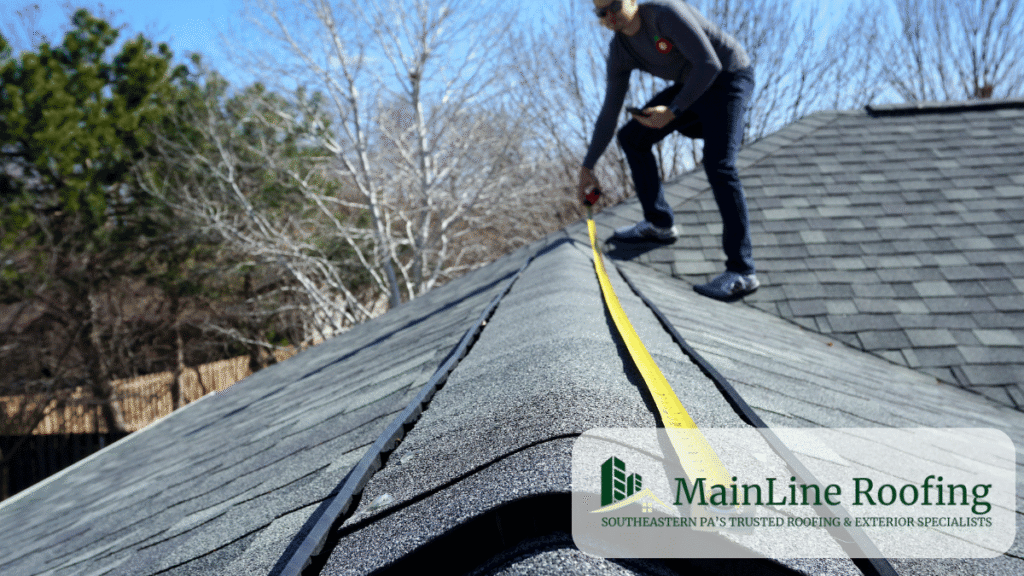
Before any roofer gives you a price, they need to know how big your roof is. That measurement comes down to one number: roof squares.
If you want to understand your estimate, check a contractor’s math, or just get a rough idea before anyone comes out, knowing how to measure roof squares is a practical skill. It is not complicated once you understand what you’re actually measuring and why.
This guide walks through everything. What a roofing square is, how to calculate your roof area, how pitch changes the number, and what it all means when you’re looking at a replacement quote for a home in Bryn Mawr, Haverford, Wayne, or anywhere else on the Main Line.
Want a Professional Measurement?
Mainline Roofing Pros measures every roof before giving you an estimate. No guesswork, no inflated numbers.
What Is a Roofing Square?
A roofing square is simply 100 square feet of roof surface. That’s it.
Roofers use squares as a standard unit because it keeps estimates clean. Instead of saying “your roof is 2,200 square feet,” they say “your roof is 22 squares.” Same information, easier to work with when pricing materials and labor.
Every shingle bundle you buy at a supply house, every line item on a roofing estimate, every material calculation is based on this unit. So when a contractor tells you your roof is 24 squares and another says 28 squares, you want to know which one is right.
Quick definition: 1 roofing square = 100 square feet of roof surface area. A 2,400 sq ft roof surface = 24 squares.
Two Ways to Measure Your Roof
You can get a reasonable measurement without ever climbing up there. Both methods work. One is more accurate than the other.
Method 1: Measure From the Ground (Footprint Method)
This is the easiest starting point. You measure the footprint of your house from the ground, calculate the area, and then apply a pitch multiplier to account for the slope.
Here’s how it works:
Measure the length and width of your home
Walk around the outside of the house with a tape measure. Measure the full length and width at the base, including any attached garages or additions that fall under the roofline. If your home isn’t a simple rectangle, break it into sections and measure each one separately.
Calculate the footprint area
Multiply length by width for each section. Add them together. For example: a 40-foot by 50-foot home has a footprint of 2,000 square feet.
Apply the pitch multiplier
A sloped roof covers more surface area than the flat footprint below it. The steeper the pitch, the bigger the difference. You multiply your footprint area by a pitch factor to get the actual roof surface area. See the pitch table below for the right multiplier.
Divide by 100 to get squares
Take your adjusted roof surface area and divide by 100. That’s your square count.
Method 2: Measure Directly on the Roof
If you can safely access your roof, direct measurement is more accurate. You measure each plane of the roof separately, calculate the area of each, add them together, and divide by 100.
For a simple gable roof, you have two planes. Measure the length and width of each slope, multiply them, add the two results, and divide by 100.
For a hip roof, a cross-gable roof, or a home with dormers, you have more sections. Measure each one and add them up. If you want a deeper look at how gable roofs are structured and how their slopes relate to measurement, that’s worth reading before you grab a tape measure.
Safety note: Roof measurement from the ground or from aerial tools is accurate enough for most estimates. Only go on the roof if you have proper footwear, a stable ladder, and someone with you. Wet or algae-covered roofs are slippery.
Understanding Roof Pitch and Why It Matters
Roof pitch is the measurement of how steep a roof is. It is expressed as a ratio of rise to run. A 6/12 pitch means the roof rises 6 inches for every 12 inches of horizontal run.
Pitch directly affects roof area. A 6/12 roof covers more surface than a 4/12 roof over the same footprint. That means more shingles, more underlayment, more labor, and a higher total cost.
This is also why two identical houses can have very different roofing costs. The steeper the pitch, the larger the actual roof area and the harder the work is to perform safely.
How to Estimate Your Roof Pitch
You don’t need to get on the roof to get a usable pitch estimate. Here’s a simple way to do it from the attic or from the ground.
From the attic: Hold a level against the underside of a rafter. At the 12-inch mark, measure straight up to the rafter. That vertical measurement is your rise. If it’s 6 inches, your pitch is 6/12.
From the ground: Use a pitch finder app or a smartphone level app. Hold the phone against the rake edge of the roof (the sloping edge at the end of a gable) and read the angle. Most pitch finder apps convert this to a rise/run ratio automatically.
The Pitch Multiplier Table
Once you know your pitch, use this table to find the right multiplier for your footprint area calculation.
| Roof Pitch | Degrees | Multiplier | Example: 2,000 sq ft footprint |
|---|---|---|---|
| 2/12 | 9.5° | 1.02 | 2,040 sq ft / 20.4 squares |
| 3/12 | 14° | 1.03 | 2,060 sq ft / 20.6 squares |
| 4/12 | 18.4° | 1.05 | 2,100 sq ft / 21 squares |
| 5/12 | 22.6° | 1.08 | 2,160 sq ft / 21.6 squares |
| 6/12 | 26.6° | 1.12 | 2,240 sq ft / 22.4 squares |
| 7/12 | 30.3° | 1.16 | 2,320 sq ft / 23.2 squares |
| 8/12 | 33.7° | 1.20 | 2,400 sq ft / 24 squares |
| 9/12 | 36.9° | 1.25 | 2,500 sq ft / 25 squares |
| 10/12 | 39.8° | 1.30 | 2,600 sq ft / 26 squares |
| 12/12 | 45° | 1.41 | 2,820 sq ft / 28.2 squares |
Most Main Line homes fall between 5/12 and 9/12 pitch. Older stone homes in Villanova and Gladwyne sometimes run steeper. Ranchers and Cape Cods often sit lower. The minimum pitch for asphalt shingles matters here too, because very low-slope sections need different materials entirely.
A Full Example: Step by Step
Let’s walk through a real calculation for a typical Colonial in the area.
The home: A two-story Colonial with a simple gable roof, 40 feet wide and 55 feet long. The garage is attached and sits under the same roofline. Total footprint including the garage is 40 x 55 = 2,200 square feet.
The pitch: The homeowner measured from the attic and got 7 inches of rise per 12 inches of run. So the pitch is 7/12, and the multiplier is 1.16.
The calculation:
- Footprint: 2,200 sq ft
- Pitch multiplier for 7/12: 1.16
- Adjusted roof area: 2,200 × 1.16 = 2,552 sq ft
- Divide by 100: 25.52 squares
- Round up to 26 squares for ordering materials
A roofer would then add waste factor (more on that below) to get to the final material order.
Use Our Roofing Estimate Calculator
Get a ballpark cost range for your roof based on size, pitch, and material type before calling anyone.
Try the CalculatorWhat About Waste Factor?
Roofers always order more material than the calculated square count. This is called waste factor, and it accounts for cuts, overlaps, valleys, hips, ridges, and starter strips.
A standard waste factor for a simple gable roof is about 10 to 15 percent. A complex roof with lots of valleys, dormers, and hips can run 15 to 20 percent or higher.
So for that 26-square Colonial above, a roofer might order 29 to 30 squares of shingles to make sure they have enough to complete the job and account for any cuts or damaged bundles.
When reviewing an estimate, waste factor should be built in. If a contractor’s material count seems low for your roof’s complexity, ask them how they arrived at it.
How Many Bundles Per Square?
Most standard asphalt shingles come three bundles to a square. So a 26-square roof needs about 78 bundles of shingles before waste factor is added.
Some premium or heavyweight shingles come four or even five bundles per square because each bundle is lighter. The packaging will always tell you how many bundles cover one square.
| Shingle Type | Bundles per Square | Notes |
|---|---|---|
| Standard 3-tab | 3 | Most common; rarely installed on new work today |
| Architectural / dimensional | 3 | Standard for most residential replacements |
| Designer / heavyweight architectural | 4 | Heavier profile; four lighter bundles per square |
| Premium / luxury shingles | 4–5 | Varies by manufacturer; check bundle coverage |
Complex Roofs: Handling Dormers and Multiple Sections
Most homes in Merion Station, Havertown, and across the Main Line are not simple rectangles. They have dormers, additions, bay window roofs, porch sections, and sometimes flat areas over garages.
For these homes, the approach is the same but you measure each section separately.
- Break the roof into individual planes or sections
- Measure the length and width of each section on the roof surface
- Calculate the area of each section
- Add all sections together
- Divide the total by 100 for squares
Dormers are their own small roof structures. Each dormer has a front face and two side slopes. Measure each surface and add them to the total.
Flat or low-slope sections over porches or garages are measured the same way as any other section. The key difference is that these areas use different roofing materials, so they may be calculated and priced separately on your estimate.
Using Technology to Measure
Most professional roofers today use aerial measurement software that pulls satellite and aerial imagery to calculate roof area, pitch, and section count automatically. Tools like EagleView and GAF’s measurement services produce detailed reports that most contractors rely on for estimates.
These reports are generally accurate within a few percent on standard homes. On homes with unusual shapes, complex dormers, or very low-pitch sections, a manual measurement may still be needed to verify.
When you get a detailed estimate from Mainline Roofing Pros, the measurements come from a combination of aerial data and direct on-site inspection. That way you’re not paying for squares that aren’t there, and we’re not underordering materials because of a missed section.
What Roof Square Count Means for Your Estimate
Your square count drives most of what you see on a roofing estimate. More squares means more shingles, more underlayment, more labor hours, and a higher total. Understanding the number helps you evaluate competing bids.
If two contractors measure your roof and come back with significantly different square counts, ask each of them to walk you through their measurement. It’s a reasonable question, and a good roofer will have no problem explaining it.
If you’re trying to figure out whether repair or replacement makes more financial sense, knowing your square count and approximate material cost per square is a useful starting point. Our guide on when to repair vs. replace your roof covers that decision in detail.
Typical Roof Square Counts for Common Home Types
This is a rough reference. Actual counts depend on pitch, roof complexity, and overhangs. But it gives you a ballpark to compare against before anyone measures your home.
| Home Type | Approximate Footprint | Typical Pitch | Estimated Roof Squares |
|---|---|---|---|
| Small Cape Cod | 900–1,200 sq ft | 8/12–10/12 | 12–18 squares |
| Ranch or rambler | 1,200–1,800 sq ft | 3/12–5/12 | 13–20 squares |
| Twin or rowhome | 700–1,200 sq ft | 5/12–8/12 | 9–16 squares |
| Standard Colonial | 1,500–2,200 sq ft | 6/12–8/12 | 20–30 squares |
| Larger Colonial with garage | 2,200–3,000 sq ft | 6/12–9/12 | 28–42 squares |
| Older stone home (Main Line) | 2,000–3,500+ sq ft | 8/12–12/12 | 28–55+ squares |
FAQs About Measuring Roof Squares
Can I measure my roof without going on it?
Yes. The footprint method gives you a solid estimate without leaving the ground. Measure your home’s base dimensions, multiply by the pitch factor, and divide by 100. For a professional estimate, we use aerial measurement tools that are accurate and don’t require accessing your roof.
How do I find my roof pitch without a ladder?
A few options. You can use a smartphone pitch finder app held against the rake edge of the roof from the ground. You can also access your attic and measure the rise per 12 inches of run along a rafter using a level and tape measure. Many building permits also list roof pitch if your home has had recent work.
How many shingle bundles do I need per square?
Standard architectural shingles come three bundles per square. Some premium shingles come four per square. Always check the bundle coverage listed on the packaging to confirm before ordering.
Does the square count include the garage?
It depends on your roof. If your garage is attached and falls under the same continuous roofline as the house, it’s included. If it’s a detached garage with its own roof, that’s measured and priced separately.
Why do different contractors give different square counts?
Different measurement methods and rounding practices can cause small variations. A larger gap usually means one contractor missed a section, used different pitch assumptions, or is not including overhangs. Always ask contractors to explain their measurement approach if the numbers don’t match.
How does waste factor affect the total materials ordered?
On a simple gable roof, roofers typically add 10 to 15 percent for waste. On complex roofs with dormers, hips, and multiple valleys, 15 to 20 percent is more realistic. This extra material accounts for cuts at ridges, valleys, and edges that can’t be used elsewhere.
More Helpful Roofing Guides from Mainline Roofing Pros
Serving homeowners across the Main Line, Delaware County, Montgomery County, and Chester County.
Bottom Line
Measuring roof squares is not a complicated process once you know what you’re looking for. Get the footprint, know your pitch, apply the multiplier, and divide by 100. That gives you a number you can use to check an estimate, compare bids, or plan ahead for a replacement.
Most homeowners in Havertown, Newtown Square, Media, and across the region don’t need to do this math themselves. But knowing how it works puts you in a much better position when someone hands you a quote and calls it fair.
Mainline Roofing Pros serves homeowners across the Main Line, Delaware County, Montgomery County, and Chester County. If you want a professional measurement and a straight estimate, reach out. We’ll walk you through the numbers.
Ready to Get an Accurate Roof Measurement?
Mainline Roofing Pros measures every roof before quoting. No inflated numbers, no surprises. Serving the Main Line, Delco, Montco, and Chester County.

Founder & Owner of Main Line Roofing Pros. 22+ years of local roofing expertise serving Main Line, Delco, Montco & Chesco homeowners with honest, high-quality work.