
What Is the 25% Rule for Roofing? When Repairs Trigger Full Replacement
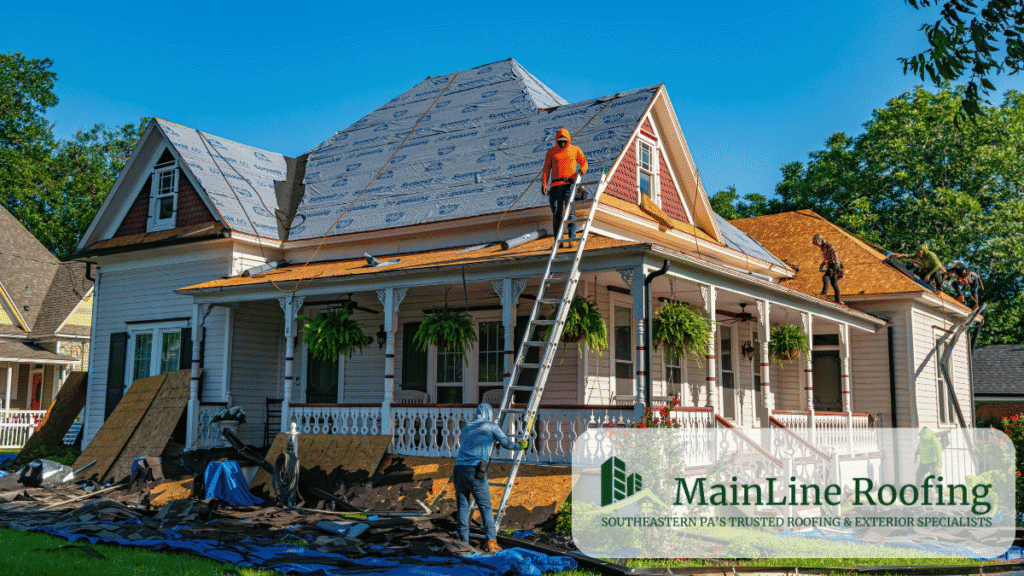
You called a roofer about a leak. They did a repair. A few months later, another section started going. Now someone is telling you the whole roof has to come off.
That is the 25% rule at work. It catches a lot of homeowners off guard, and it shows up in two separate situations: building code enforcement and insurance claims. The implications are different in each case, but the core idea is the same.
This guide covers exactly what the rule is, how it gets applied, when it matters for your home in Bryn Mawr, Haverford, or anywhere across the Main Line, and what your options are when you hit that threshold.

The Short Answer: What Is the 25% Rule?
The 25% rule states that if more than 25% of a roof’s total surface area is repaired or replaced within a 12-month period, the entire roof must be brought up to current building codes rather than just patched. In insurance contexts, a similar threshold determines whether a carrier will pay for a full replacement versus a partial repair.
Think of it as a tipping point. Below 25%, a repair is a repair. Above 25%, the work legally becomes a replacement, and current code requirements apply to the whole roof.
The rule exists for a practical reason. Patching a small section of an old roof is one thing. But once a significant portion of the roof is being worked on, code says the entire system should meet current safety and performance standards. You can’t add new materials to a degraded base and call it a job well done.
Not Sure Where Your Roof Stands?
Mainline Roofing Pros inspects and measures roofs across the Main Line, Delco, Montco, and Chester County. We’ll tell you exactly what you’re dealing with.
Where the 25% Rule Comes From
The rule is rooted in the International Building Code, commonly called the IBC, and its residential counterpart the International Residential Code, the IRC. These model codes form the basis for most local building codes across the country, including the townships and boroughs throughout Delaware, Montgomery, and Chester Counties.
The specific language in the code says that when the repairs to an existing roof exceed 25% of the roof area within any 12-month period, the entire roof must be brought into compliance with current code. That means new underlayment standards, current ventilation requirements, updated flashing specifications, and current decking conditions all come into play.
Local jurisdictions can adopt and modify these codes. In Pennsylvania, local townships can be stricter or more lenient than the base code language. In practice, most municipalities in the Philadelphia suburban area follow the IBC and IRC guidelines fairly closely.
Important: Always confirm requirements with your local building department before starting work. Radnor, Haverford, Lower Merion, and other townships each administer their own permits and inspections, and requirements can vary.

How the 25% Is Calculated
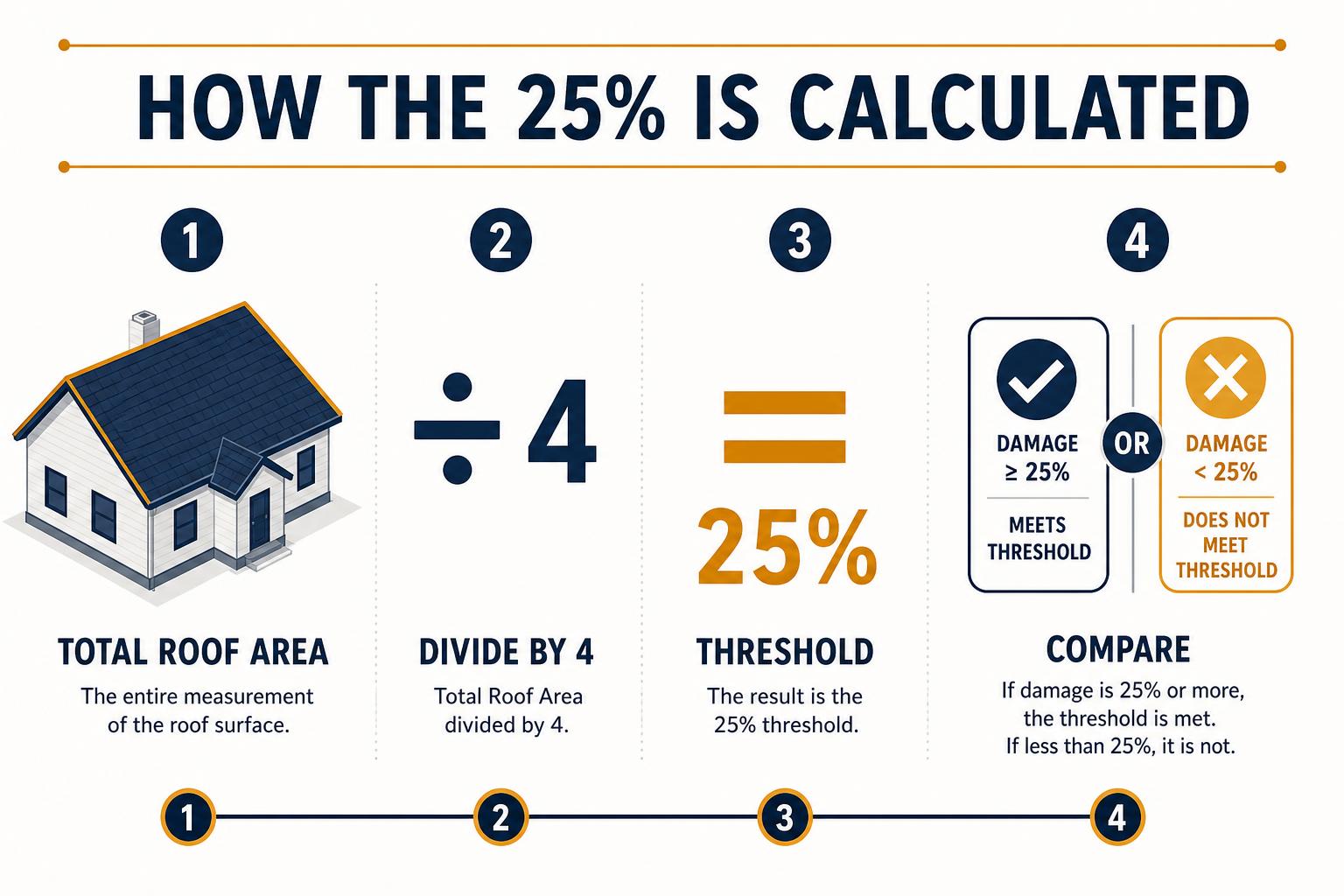
The calculation is based on total roof surface area, not the footprint of your home. That matters because a steeply pitched roof has significantly more surface area than a flat measurement of your house would suggest.
Here is how you get to the number:
- Calculate the total roof surface area in square feet, accounting for pitch
- Divide that number by 4. That is your 25% threshold
- Add up all repairs done within the past 12 months in square feet
- If that total exceeds the threshold, the 25% rule applies
For example: a home with a total roof surface of 2,800 square feet has a 25% threshold of 700 square feet. If repairs over the past year have touched 720 square feet of that roof, the rule kicks in and the full roof must be replaced and brought up to current code.
If you need a refresher on how roof surface area is measured, our guide on how to measure roof squares walks through the full calculation including pitch adjustments.
The 12-Month Window Explained
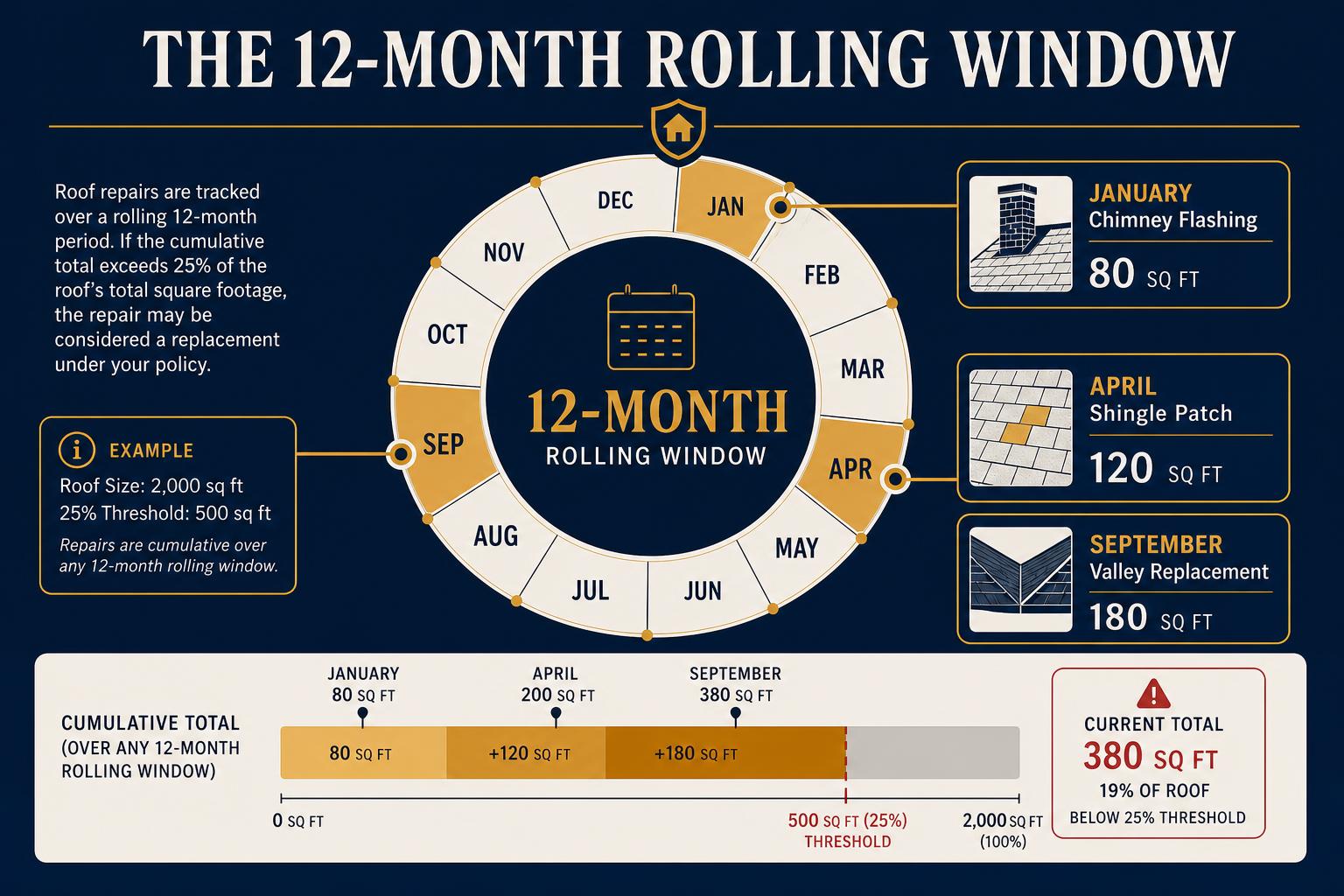
The rule is cumulative within a rolling 12-month period. That means multiple smaller repairs can add up and cross the threshold even if no single repair was large.
Say you had a chimney flashing repair in January, a shingle patch on the rear slope in April, and a valley replacement in September. None of those jobs by itself crossed 25%. But if the total square footage of those three repairs combined exceeds the threshold, the rule still applies.
This catches a lot of homeowners by surprise. They approved three separate repairs from three separate contractors and never thought of them as a single event. But from a code enforcement perspective, they are.
Watch out for this: Multiple small repairs over a calendar year can stack up past 25% without any single one triggering the rule on its own. Keep records of all roofing work with the area repaired noted.
What Triggers Full Replacement Under the Rule
Once repairs cross the 25% threshold, a few things happen:
- A building permit is typically required for the full replacement
- The entire roof must meet current code, not just the repaired section
- This can include upgraded underlayment, ice and water shield requirements, updated ventilation standards, and proper flashing specs
- Decking that does not meet current standards may need to be replaced
- Inspections will be required at key stages of the project
For older homes on the Main Line, this can mean a meaningful scope increase. A home with original 1950s board decking, inadequate soffit vents, and aging flashing details may need significant underlying work before new shingles go down.
That sounds like bad news. In reality, it usually is not. Bringing a roof up to current standards is the right outcome for long-term performance. A properly ventilated, properly flashed roof with solid decking lasts significantly longer than one built on a degraded base.

The 25% Rule and Insurance Claims
The 25% rule also shows up in insurance conversations, but it works a little differently than the building code version.
Insurance carriers use similar logic to decide whether storm damage warrants a full roof replacement or a partial repair. The specifics depend on your policy and your carrier, not a universal code standard, but the 25% threshold is commonly referenced.
When an adjuster assesses storm damage, they are looking at how much of the roof was affected. If the damage is concentrated in a small section, they may approve a repair. If damage is more widespread and crosses their threshold, they approve full replacement.
Two important things to know here:
- Matching matters. In Pennsylvania, insurers are generally required to replace materials that match the existing roof in appearance. If your shingle color or profile is discontinued, they may owe you a full replacement even if the physical damage was partial.
- Policy language varies. Some policies have their own percentage thresholds written in, which may differ from the building code standard. Read your policy or have your public adjuster review it before accepting a partial settlement.
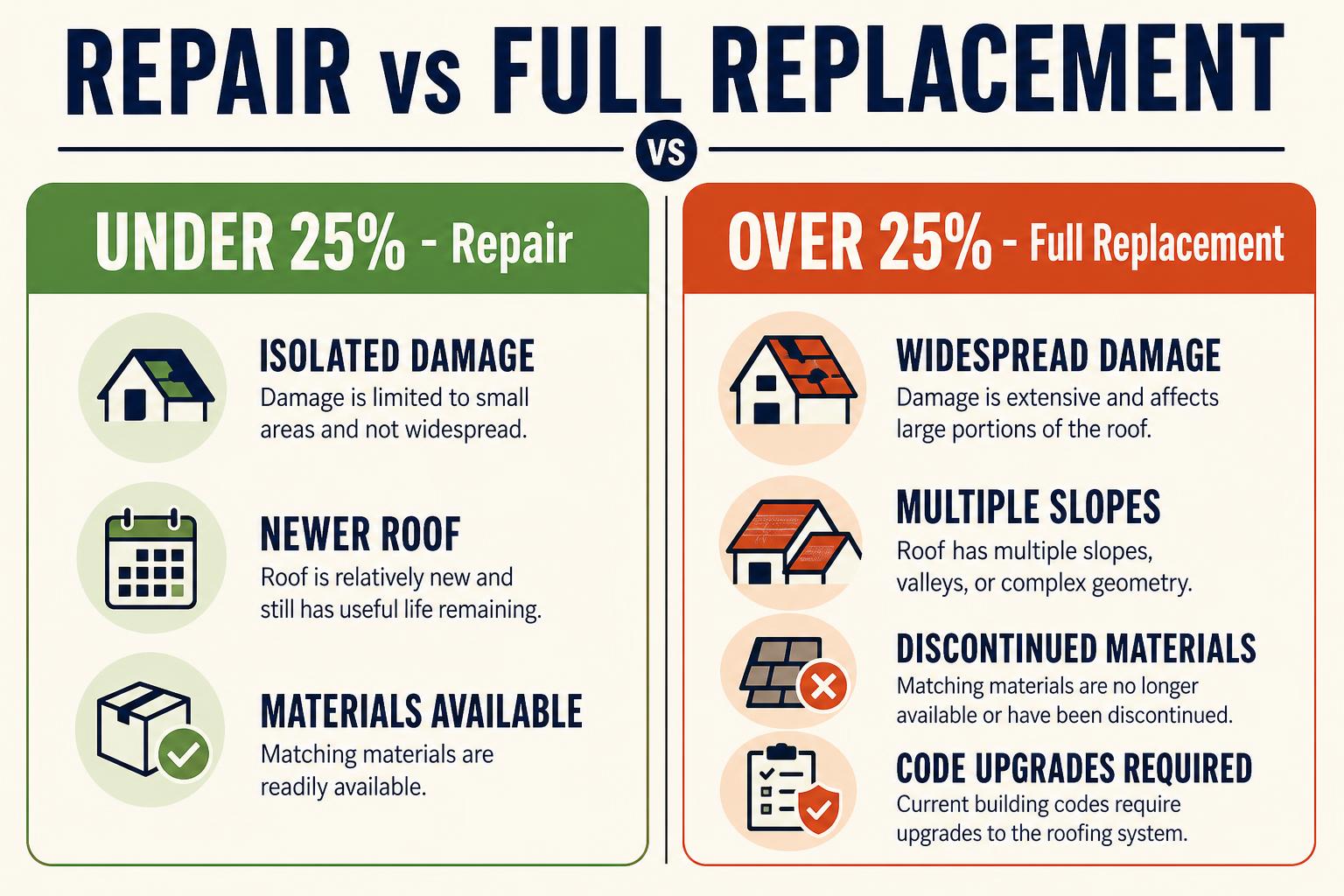
Likely Full Replacement
Damage covers more than 25% of total roof area. Storm affects multiple slopes. Materials are discontinued or can’t be matched. Underlying structure is compromised. Multiple prior repairs have stacked up near the threshold.
Likely Partial Repair
Damage is isolated to one small section. Roof is relatively new and materials are still available. Prior repair history is minimal. Structural components are in sound condition. Total repair area stays well below the threshold.
Does the 25% Rule Apply to Every Roof Material?
The rule applies broadly to roof coverings, but the specific implications can vary by material.
| Roof Material | Does 25% Rule Apply? | Notes |
|---|---|---|
| Asphalt shingles | Yes | Most common scenario. Exceeding 25% triggers full replacement and code compliance. |
| Slate | Yes | Slate repair is often grandfathered, but widespread repair work still triggers review. Historic districts may have additional considerations. |
| Cedar shake | Yes | Same threshold applies. Full replacement must meet current fire rating and ventilation standards. |
| Metal roofing | Yes | Applies to metal panels and standing seam systems. Repairs must still stay under 25% to avoid full code upgrade requirement. |
| Flat / low-slope (EPDM, TPO) | Yes | Cumulative patch work on flat roofs counts toward the threshold. Drainage and slope requirements come into play on full replacement. |
Real Scenarios: How This Plays Out on Main Line Homes
Scenario 1: The Incremental Repair Problem
A homeowner in Havertown has a 25-year-old asphalt shingle roof. Over the past year, they had a valley patched in the spring after winter ice damage, a section of the rear slope re-shingled after a tree branch came down, and a chimney flashing repair done in the fall. Total roof area is 2,400 square feet. Total repaired area across those three jobs: 680 square feet. That’s just over 28%. The 25% rule now applies. The next contractor who pulls a permit for any additional work on that roof will be required to replace the whole thing and bring it to current code.
Scenario 2: The Storm Claim That Becomes a Full Replacement
A Merion Station homeowner files a claim after a hailstorm. The adjuster walks the roof and finds damage concentrated on the front and one side slope, covering roughly 30% of the total roof area. The insurer approves a full replacement. Because the work now triggers the 25% rule, current code requirements apply, including upgraded ice and water shield along the eaves and at all valleys, a continuous ridge vent to replace the two box vents currently on the roof, and proper step flashing at the dormers where the previous installation was surface-sealed only.
Scenario 3: The Planned Repair That Gets Complicated
A homeowner in Wayne wants to repair a section of roof over a rear addition. The section is about 320 square feet on a total 1,800 square foot roof. That’s just under 18%, which keeps them under the threshold. One repair is fine. But the contractor notices the front slope also has significant wear. Adding that work would push them to roughly 600 square feet, or 33%. At that point, the better financial decision is usually a full replacement. The cost difference is smaller than most homeowners expect, and the result is a complete system instead of a patched one.
Should You Try to Stay Under 25%?
It is a fair question. Some homeowners wonder if they can just do smaller repairs to avoid triggering the rule.
Strategically staying just under 25% can work as a short-term approach on a roof that still has real life left in it. But on an older roof that is broadly failing, piecemeal repairs rarely end well. You spend money repeatedly, the repairs don’t hold, and at some point the full replacement becomes unavoidable anyway.
The better frame is this: if your cumulative repairs are approaching 25%, your roof is telling you something. It’s asking for a replacement. The 25% rule is just the paperwork version of that same conversation.
Our guide on when to repair vs. replace your roof covers this decision in more detail and gives you a framework for making the right call based on your specific situation.
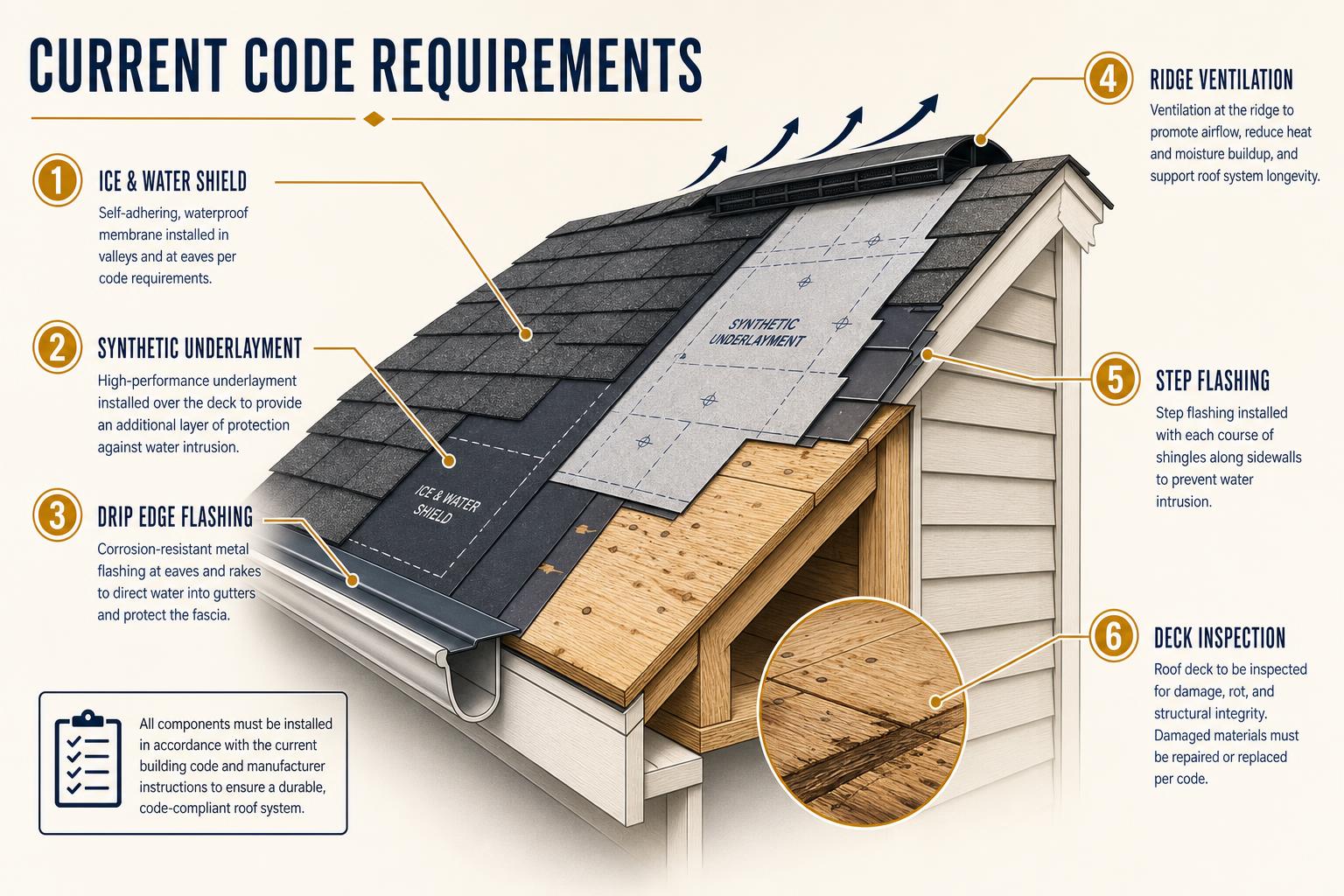
What Current Code Requirements Look Like
When the 25% rule triggers a full replacement, here is what current building code typically requires in most Pennsylvania jurisdictions:
- Ice and water shield along all eaves, in all valleys, and around all penetrations
- Synthetic underlayment over the full deck before shingles
- Proper attic ventilation meeting the 1:150 or 1:300 ratio depending on configuration
- Drip edge flashing at eaves and rakes
- Step and counter flashing at all chimneys and wall transitions, properly integrated rather than surface-sealed
- Decking inspection and replacement of any soft, rotted, or damaged sheathing
- Ridge ventilation that meets current airflow calculations
On a well-maintained newer home, most of these requirements may already be met. On an older home with original materials and decades of prior repairs, bringing everything up to current code can add meaningful scope to the project. That scope is worth it. Understanding how roof flashing should be installed, for example, makes it clearer why surface-sealed counter flashing from 20 years ago is not code-compliant today.
Permits and the 25% Rule
In most municipalities across the Main Line and surrounding counties, roofing work that meets the 25% threshold requires a building permit. The permit process involves:
- Submitting an application with scope of work and material specs
- Paying a permit fee, typically based on project value
- Having the work inspected at required stages
- Receiving a certificate of completion when the work passes final inspection
Some contractors skip the permit process on roofing work. That is a problem for the homeowner, not just the contractor. Unpermitted work can complicate home sales, void manufacturer warranties, and create liability if the roof fails. Always ask your contractor whether a permit is required for your job and verify with your township directly if you’re not certain.
Good to know: A reputable contractor will pull the permit for you as part of the job. If a contractor tells you a permit isn’t needed for significant roof work, that’s worth a second opinion.

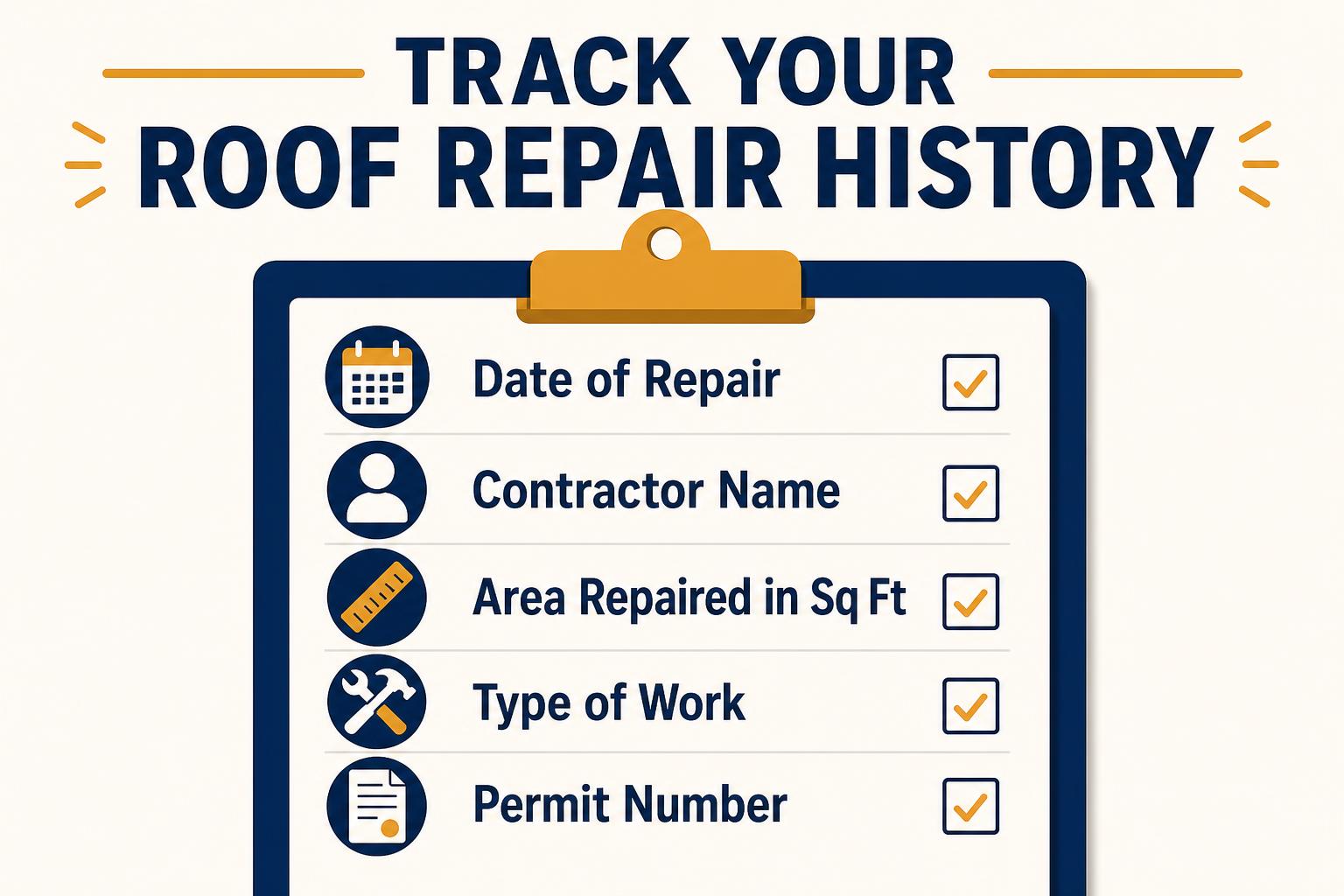
How to Track Your Roof’s Repair History
Keeping a simple record of every roofing job done on your home is worth doing. Note the date, the contractor, the area repaired in square feet, and what the work involved. That record helps you:
- Know where you stand relative to the 25% threshold before scheduling more work
- Support an insurance claim with documented repair history
- Provide accurate information to a buyer if you sell the home
- Hold contractors accountable to the work they said they did
Most homeowners don’t have this information. That’s understandable. But if you’re heading into a significant repair or a replacement conversation, it’s helpful to gather what records you do have.
FAQs About the 25% Rule for Roofing
Does the 25% rule apply in Pennsylvania?
Yes. Pennsylvania municipalities generally adopt the International Building Code and International Residential Code, both of which include the 25% threshold for triggering full replacement requirements. Local townships enforce this through their permitting and inspection processes. Check with your specific township for the exact language they apply.
What counts as part of the 25%?
Any roofing work that replaces, repairs, or re-covers roof covering materials counts. This includes shingle replacements, valley work, flat roof patching, and re-roofing over existing material. General maintenance like cleaning, resealing, or caulking typically does not count toward the threshold.
Can I re-roof over existing shingles to avoid the rule?
Not reliably. Most codes allow one layer of re-roofing over existing shingles, but the same 25% threshold still applies to that work. Adding a second layer over existing shingles also creates its own problems with weight, ventilation, and the ability to inspect decking condition. It is rarely the right long-term answer.
Does the 25% rule apply to insurance claims differently than code enforcement?
Yes. Building code enforcement is governed by local permitting rules. Insurance thresholds are set by your policy language and your carrier’s claims guidelines. They often align around the 25% figure but are administered separately. A code inspector and an insurance adjuster are two different parties with different authority over your project.
What happens if a contractor does work over 25% without a permit?
The homeowner bears the risk. Unpermitted work over the 25% threshold may not meet current code, may not be covered by the contractor’s warranty, and can create complications during a home sale or a future insurance claim. If discovered during a sale inspection, the work may need to be redone with a permit and inspection before closing.
If the 25% rule triggers a full replacement, does insurance have to pay for the whole roof?
It depends on your policy. Some policies include code upgrade coverage, also called Ordinance or Law coverage, which pays for the additional cost of bringing the roof up to current code as part of a covered claim. Without that coverage, you may be responsible for the code compliance costs even if the underlying damage is covered. Review your policy for Ordinance or Law language before filing a claim.
Is it ever smart to do a partial repair that keeps me under 25%?
Sometimes yes. If your roof has plenty of life left, the damage is genuinely isolated, and you’re confident the repair will hold, staying under the threshold makes sense. Where it goes wrong is when homeowners do repeated partial repairs on a roof that is broadly failing. At that point, the 25% rule is doing you a favor by pushing toward a full replacement.
More Helpful Roofing Guides from Mainline Roofing Pros
Serving homeowners across the Main Line, Delaware County, Montgomery County, and Chester County.
Bottom Line
The 25% rule is not a technicality to work around. It’s a signal that a roof has crossed a threshold where patchwork no longer makes sense as a long-term strategy.
Understanding how it works puts you in a better position when you’re talking to a contractor, reviewing an insurance claim, or deciding whether another repair is worth the money. You don’t need to be a code expert. You just need to know the number, know how it’s calculated, and know that the 12-month window is cumulative.
If you’re approaching that threshold or already past it, the conversation you want to have is about what a full replacement actually costs and what it gets you. That’s almost always a better frame than asking how to avoid one.
Mainline Roofing Pros serves homeowners across the Main Line, Delaware County, Montgomery County, and Chester County. If you want a straight assessment of where your roof stands, give us a call. We’ll measure it, walk you through the math, and give you options that make sense.
Need Help Understanding Your Roof’s Repair History?
Mainline Roofing Pros can inspect your roof, assess cumulative damage, and give you honest guidance on whether repair or full replacement is the right call.
Founder & Owner of Main Line Roofing Pros. 22+ years of local roofing expertise serving Main Line, Delco, Montco & Chesco homeowners with honest, high-quality work.