
What Is a Ridge Vent and Why Does It Matter for Your Roof?
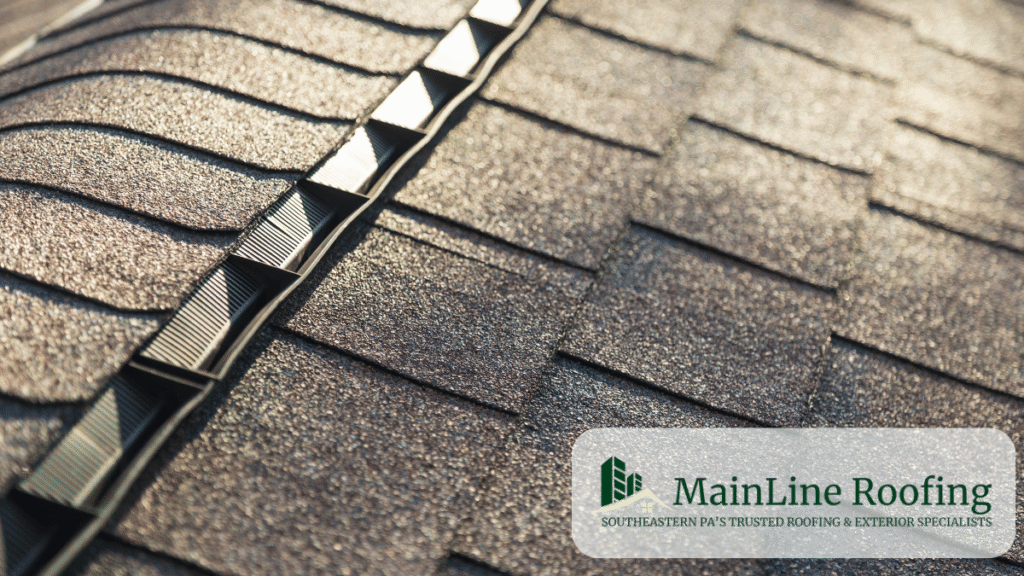
A ridge vent is the long, low-profile vent that runs along the very peak of your roof. Most homeowners never notice it. But it’s doing quiet, continuous work every day – moving hot, humid air out of your attic and helping protect your roof, your insulation, and your energy bills in the process.
This guide explains what a ridge vent is, how it works, the different types available, how it compares to other ventilation options, and what happens to a roof when attic ventilation is inadequate.
What Is a Ridge Vent?
A ridge vent is a ventilation device installed along the horizontal peak – the ridge – of a sloped roof. It runs the length of the ridge, sits under the ridge cap shingles, and allows hot and humid air to continuously escape from the attic below.
From the outside, a properly installed ridge vent is nearly invisible. The ridge cap shingles cover it, and only a small profile is visible from the ground if you know what you’re looking for. From inside the attic, you can see the slot cut in the decking just below the ridge, with the vent material covering it on the outside.
Quick definition: A ridge vent is an exhaust vent at the peak of the roof. It works as part of a balanced system with intake vents at the soffits. Together, they create continuous airflow through the attic without any moving parts or electricity.
How a Ridge Vent Works
Ridge vents work on a simple principle: hot air rises. Attic air, heated by the sun on the roof above and by heat escaping from the living space below, naturally rises toward the peak. The ridge vent gives that hot air a place to exit.
But a ridge vent alone is only half the system. For it to work properly, there must be a matching supply of cooler replacement air coming in from somewhere lower. That intake comes from soffit vents – the perforated strips or individual vents built into the underside of the roof overhangs.
The complete airflow cycle works like this:
- Cool outside air enters through soffit vents at the low edge of the roof
- That air travels up through the attic space, warming as it goes
- The warm air continues rising toward the peak
- It exits through the ridge vent at the top
- Wind passing over the ridge creates a slight negative pressure that actively pulls air out – this is the stack effect in action
This continuous, passive cycle happens without fans, motors, or electricity. It runs 24 hours a day, every day, as long as the inlet and outlet vents are clear and properly sized.
Types of Ridge Vents
Not all ridge vents are the same. There are several types used in residential construction, each with different profiles, materials, and performance characteristics.
Shingle-Over Ridge Vents
The most common type for new construction and re-roofing. These are low-profile strips of coated steel or aluminum with a mesh baffle that allows air to escape while blocking wind-driven rain and insects. Ridge cap shingles are installed over them, making them nearly invisible from the ground. Products like the GAF Cobra series and Owens Corning’s VentSure are examples of this type.
Hard Ridge Vents
A higher-profile option made from rigid plastic or metal with ventilation slots cut into the sides. Hard ridge vents provide more net free area (the actual open space for air to pass through) than some shingle-over vents, but they’re more visible from the ground. Common on commercial buildings and some residential applications where maximum airflow is needed.
Roll-Type Ridge Vents
A flexible material, often a mesh or foam-and-fabric composite, installed along the ridge before ridge cap shingles. These are often used on lower-profile ridge situations. They provide less net free area than most shingle-over vents and are less commonly used today on standard residential roofing.
Net Free Area (NFA): This is the measurement that actually matters for ventilation performance. It describes how much actual open space a vent provides for air to move through, typically measured in square inches per linear foot. When comparing ridge vent products, compare NFA rather than appearance or price.
Ridge Vent vs. Other Attic Ventilation Options
Ridge vents are not the only way to ventilate an attic. Several other vent types are commonly used, and it’s worth understanding how they compare and when each is appropriate.
| Vent Type | Location | Exhaust or Intake | Best Used When |
|---|---|---|---|
| Ridge vent | Peak of roof | Exhaust | Most residential applications with adequate soffit vents |
| Soffit vents | Underside of overhang | Intake | Used with ridge vents as the inlet side of the system |
| Box vents (static vents) | Near the ridge on the field of the roof | Exhaust | Short runs of ridge, hip roofs, or supplemental exhaust |
| Power (electric) attic fans | Near the ridge on the field of the roof | Exhaust (active) | When passive ventilation is insufficient and can’t be upgraded |
| Gable vents | Triangular wall vents at the gable ends | Either, wind-dependent | Can work alone on simple gable roofs; less effective than ridge/soffit |
| Turbine vents | Near the ridge on the field | Exhaust (wind-powered) | Supplement on older homes; noisy when worn |
The combination of ridge vent and soffit vents is considered the most effective passive ventilation system for most residential roofs. It provides balanced airflow along the full length of the roof, keeps the entire attic floor at a consistent temperature, and works silently without maintenance.
One important caution: never mix exhaust vent types in the same attic zone. Combining a ridge vent with high box vents or gable vents can create short circuits in the airflow – the exhaust vents pull air from each other rather than drawing cool air in from the soffits. This defeats the purpose of ventilation entirely. When a ridge vent is installed, high exhaust vents in the same zone should typically be blocked.
Why Attic Ventilation Matters for Your Roof
Most homeowners think of ventilation as a comfort issue – keeping the attic from getting too hot in summer. It is that. But the more important effect is on the roof itself and on the structure below it.
Summer Heat
In summer, an unventilated attic can reach temperatures of 150 degrees Fahrenheit or higher on a hot day. That sustained extreme heat cooks the shingles from below, accelerating granule loss, drying out the asphalt, and shortening the life of the roof surface. Our guide on how hot an attic gets on a 100-degree day covers this in detail. A properly ventilated attic keeps those temperatures 20 to 40 degrees lower, meaningfully extending roof life.
Winter Ice Dams
In winter, a warm attic melts snow on the roof above, and that meltwater runs down the slope until it hits the cold overhang and refreezes. The resulting ice dam builds up at the eaves, trapping water that backs under the shingles and causes leaks. A properly ventilated attic stays at roughly the same temperature as the outside air, preventing uneven snowmelt and ice dam formation. Ice and water shield at the eaves is the last line of defense – good ventilation is the first.
Moisture and Condensation
Humid air from the living space below constantly migrates into the attic through even well-insulated ceilings. Without adequate airflow, that moisture accumulates and condenses on the cold underside of the roof decking in winter. Over time, this causes mold, rot, and deterioration of the roof decking and framing. Proper ridge-and-soffit ventilation keeps the attic dry by continuously replacing humid air with drier outside air.
Shingle Warranty Compliance
Most major shingle manufacturers – GAF, CertainTeed, Owens Corning – require adequate attic ventilation as a condition of their warranty. An installation where ventilation doesn’t meet minimum requirements can void the warranty on the shingles. When a roof is replaced, a responsible contractor checks ventilation as part of the project.
Signs Your Attic Is Poorly Ventilated
Many ventilation problems show up in the living space long before the roof surface shows visible damage. Here are the signs to watch for:
- Ice dams forming at the eaves in winter, especially with icicles running from the gutter line
- Shingles curling or cupping earlier than expected for their age
- Excessive heat in upper-floor rooms in summer
- Frost or condensation visible on the underside of the roof decking in winter
- Mold or mildew smell in the attic or in upper-floor rooms
- Granules accumulating heavily in gutters on a relatively new roof
- Energy bills higher than neighboring similar homes
- Visible staining on the underside of roof decking boards
Does Every Roof Need a Ridge Vent?
Not every roof is a candidate for a continuous ridge vent. The system only works when there’s a clear, unobstructed path from soffit to ridge – and when the ridge itself is long enough to provide meaningful exhaust area.
Hip roofs have a much shorter ridge length relative to the roof area. A ridge vent on a hip roof exhausts a smaller portion of the total attic volume than on a gable roof. Hip roofs often use a combination of a short ridge vent and box vents or hip vents to achieve adequate total exhaust area.
Roofs with complex shapes – multiple valleys, dormers, intersecting ridges – may have attic zones that don’t connect cleanly to the main ridge. These zones need their own exhaust vents to be adequately ventilated.
Cathedral ceilings and finished attics require a different approach entirely. In these cases, rigid foam insulation or rafter baffles must maintain an air channel from soffit to ridge along each rafter bay, and the ridge vent exhausts that channel rather than an open attic space.
Ridge Vents During a Roof Replacement
If your home doesn’t currently have a ridge vent, a full roof replacement is the ideal time to add one. The ridge slot needs to be cut through the roof decking, and doing that as part of a tear-off and re-roof project is far more efficient than as a standalone addition later.
During a replacement, a good contractor will also verify that:
- Soffit vents are present, clear, and not blocked by insulation from inside the attic
- Rafter baffles are in place to keep the soffit-to-ridge channel open
- The total net free area of intake vents matches or exceeds the exhaust area
- No high exhaust vents remain in the same zone that would short-circuit the ridge vent
- The new ridge cap shingles are installed correctly over the vent without compressing the mesh that allows airflow
Wondering About Your Attic Ventilation?
Mainline Roofing Pros evaluates ventilation as part of every roof estimate. If your system isn’t working, we’ll tell you what needs to change and what it costs.
Frequently Asked Questions About Ridge Vents
What is a ridge vent on a roof?
A ridge vent is a passive exhaust vent installed along the peak of a sloped roof. It allows hot and humid air to continuously escape from the attic. It works with soffit vents at the eaves to create a balanced intake-exhaust ventilation system that operates without electricity or moving parts.
Can a ridge vent leak?
A properly installed ridge vent should not leak. The design includes internal baffles that deflect wind-driven rain away from the opening. Leaks can occur if the vent is damaged, if the ridge cap shingles above it are improperly installed or worn, or if the vent is the wrong product for the exposure level at the ridge. If you’re seeing water in the attic near the ridge, it’s worth having a contractor check both the vent and the cap shingles above it.
Do I need soffit vents for a ridge vent to work?
Yes. A ridge vent without adequate soffit intake vents will draw air from wherever it can find it – often from inside the living space through light fixtures, attic access hatches, or bypasses in the insulation. This is worse than no ventilation at all. The two systems must work together. As a rule of thumb, intake area should equal or slightly exceed exhaust area.
Can I have a ridge vent and box vents at the same time?
Not in the same attic zone. Mixing exhaust vents creates short circuits – the vents pull air from each other rather than from the soffits below. If you add a ridge vent to a roof that has existing high box vents, those box vents should be closed or relocated lower on the roof where they can serve as intake rather than exhaust. This is worth discussing with your contractor during any re-roofing project.
How do I know if my ridge vent is working?
On a cold winter day, go into your attic. If your ventilation is working correctly, the attic should feel cold – close to outside air temperature. If it feels significantly warmer than outside, the ventilation isn’t adequate. In summer, an attic that feels like an oven when it’s 85 outside is another sign of poor airflow. You can also hold a smoke pencil or incense near the soffit vents to see if air is being drawn in.
Does a ridge vent help with ice dams?
Yes, significantly. Ice dams form when a warm attic melts snow on the upper roof, and that meltwater refreezes when it reaches the cold overhang. A properly ventilated attic – with good ridge and soffit ventilation – stays close to outside air temperature and prevents the uneven snowmelt that causes ice dams. Ventilation is one of the most effective ways to prevent ice dam damage in Pennsylvania winters.
How long does a ridge vent last?
Most quality ridge vent products are designed to last the life of the roof. They’re typically replaced as part of a full roof replacement rather than independently. The most common failure modes are physical damage, UV degradation of the baffle material over many years, or crushing from improper installation of ridge cap shingles.
More Helpful Roofing Guides from Mainline Roofing Pros
Serving homeowners across the Main Line, Delaware County, Montgomery County, and Chester County.
Bottom Line
A ridge vent is a small, passive component that makes a meaningful difference in how long your roof lasts and how well your home performs. When it’s part of a balanced system with proper soffit intake, it keeps attic temperatures down in summer, prevents ice dams in winter, protects your decking and insulation from moisture damage, and keeps your shingle warranty intact.
If your home in Haverford, Gladwyne, Radnor, or anywhere in the area doesn’t have a ridge vent, the right time to add one is during your next roof replacement. We evaluate ventilation on every project and recommend it as part of a properly functioning roof system, not as an add-on.
Want to Know If Your Ventilation Is Working?
Mainline Roofing Pros evaluates attic ventilation as part of every roof inspection and estimate. We’ll tell you exactly what you have, what you need, and what it costs.

Founder & Owner of Main Line Roofing Pros. 22+ years of local roofing expertise serving Main Line, Delco, Montco & Chesco homeowners with honest, high-quality work.