
What Is Roof Decking? A Homeowner’s Guide to Roof Sheathing
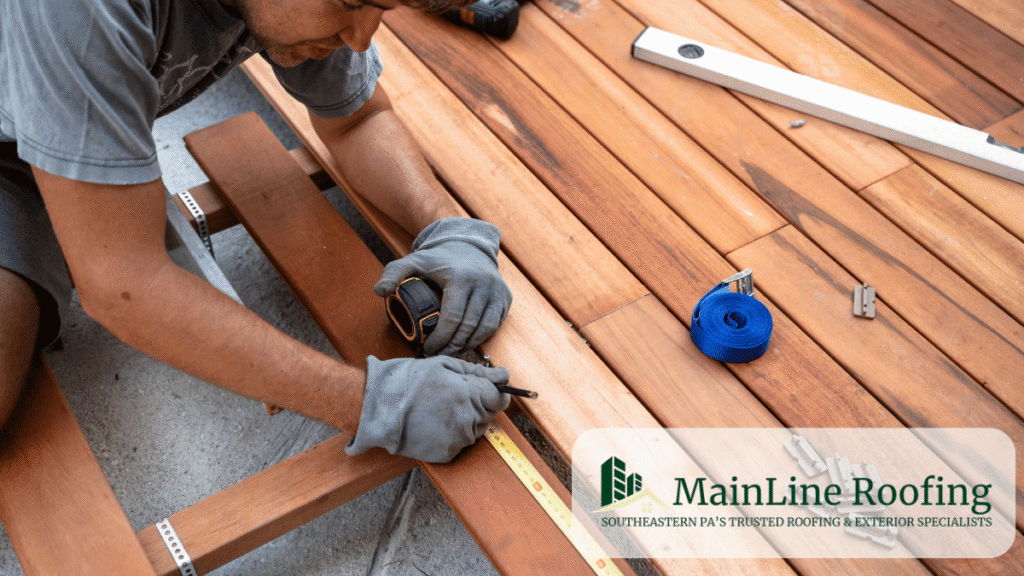
There’s a layer of your roof that most homeowners never see and rarely think about until something goes wrong. It’s called roof decking. It sits between the structural framing and the shingles above, and its condition has a direct effect on how your roof performs, how long your shingles last, and what a replacement project actually costs.
This guide explains what roof decking is, what it’s made of, why it matters, how to recognize damage, and what happens when it needs to be replaced.
What Is Roof Decking?
Roof decking – also called roof sheathing – is the layer of solid panel material that covers the roof framing and gives the rest of the roof system something solid to attach to. It’s nailed directly to the rafters or trusses, creating a continuous, flat surface that runs from the ridge down to the eaves.
Everything above the decking – the ice and water shield, the underlayment, the shingles, the flashing, the ridge vent – is attached to or rests on the decking. Everything below it is the structural framing. The decking is the bridge between the two systems.
Quick definition: Roof decking (also called sheathing) is the layer of wood panels nailed across your roof framing. It’s the foundation your shingles and underlayment attach to. Without sound decking, a roof replacement can’t be done properly.
What Is Roof Decking Made Of?
Modern residential roof decking is almost always one of two materials: plywood or oriented strand board (OSB). Older homes sometimes have different materials, which we’ll cover separately.
Plywood
Plywood is made from thin wood veneers glued together with the grain of each layer perpendicular to the one above and below. This cross-grain construction gives plywood strength in multiple directions, good resistance to warping, and predictable behavior when exposed to moisture.
Plywood used in roofing is typically 1/2 inch or 5/8 inch thick, rated for structural use, and marked with its span rating – the maximum distance between framing members it can bridge without excessive deflection.
Oriented Strand Board (OSB)
OSB is made from compressed strands of wood fiber bonded with resin under heat and pressure. It became widely used in residential construction in the 1980s and 1990s because it’s less expensive than plywood and uses raw material more efficiently.
Modern OSB performs comparably to plywood under normal roofing conditions. Its main weakness is moisture: OSB absorbs water more readily than plywood at the edges of panels and cut edges, and when it does, it swells and can delaminate more readily. For this reason, quick and proper installation – keeping panels dry during construction and covering them promptly – matters more with OSB than plywood.
| Feature | Plywood | OSB |
|---|---|---|
| Construction | Cross-laminated wood veneers | Compressed wood strands with resin |
| Moisture resistance | Better at panel edges and faces | More susceptible to edge swelling |
| Strength | Comparable for roofing spans | Comparable for roofing spans |
| Cost | Higher | Lower (10 to 20% less) |
| Common on homes built | Pre-1990s and premium construction | 1990s to present in most production homes |
| Preferred for | Areas with high moisture exposure risk | Standard residential roofing |
Older Decking Materials
Homes built before the 1950s often have skip sheathing or board sheathing instead of panels. Skip sheathing consists of individual 1×6 or 1×8 boards spaced apart with gaps between them – originally designed for wood shingles or shakes that needed airflow from below. Solid board sheathing is individual boards installed tight to each other without gaps.
Neither of these is compatible with modern asphalt shingles without modification. Skip sheathing requires plywood or OSB overlay boards to create a solid surface before new shingles can be installed. Many older homes in Gladwyne, Villanova, and across the historic Main Line have original board sheathing under their current roofing, which becomes relevant when a replacement is planned.
Why Roof Decking Matters
The decking is the foundation everything else sits on. If it’s compromised, every layer above it is compromised too. Here’s why it matters at each stage:
For Shingle Attachment
Shingles are nailed through the underlayment into the decking below. For a nail to hold properly – especially under wind load – it needs to penetrate into solid, dry wood. Soft, spongy, or delaminated decking doesn’t hold nails effectively. In a wind event, shingles nailed into compromised decking are far more likely to pull off.
For Roof Structure
Beyond just holding shingles, the decking provides lateral rigidity to the whole roof structure. It ties the framing members together and helps the roof act as a single system under load. Decking that’s deteriorated, has large sections replaced inconsistently, or was installed with improper fasteners doesn’t contribute to structural performance the way solid, well-attached decking does.
For Ventilation
The air gap between the decking and the insulation below – maintained by rafter baffles or the geometry of the attic – is what allows ventilation air to move from the soffits to the ridge vent. Decking that sags into that channel, or insulation that has been pushed up against the decking without baffles, can block airflow and lead to moisture accumulation.
Signs of Decking Damage
Decking damage often shows up in the attic before it’s visible from the outside. Here are the warning signs in both places:
Signs Visible From Inside the Attic
- Dark staining or water marks on the underside of the decking panels
- Soft, spongy areas when you press on the decking from below
- Visible mold or mildew growth on the panel surfaces
- Panels that are delaminating, separating at the plies or swelling at the edges
- Daylight visible through gaps or holes
- Areas where the decking feels noticeably thinner or compressed
Signs Visible From the Roof Surface
- Visible dips or wavy sections on the roof plane – sometimes called “pillowing” between rafters
- Shingles that feel soft or springy underfoot in specific areas
- Areas where the shingle surface has pulled or distorted around fasteners
- Persistent leaks in a specific area that don’t resolve after flashing repairs
The attic is the best place to look. Many decking problems that would cost thousands to address if left until a full re-roof are much easier to find and assess with a quick attic inspection. If you haven’t looked at your attic decking recently and your roof is more than 15 years old, it’s worth doing before your next storm season.
When Does Decking Need to Be Replaced?
Not all damaged decking needs to be replaced entirely. Whether replacement is needed depends on the extent and type of damage.
Spot Repairs
If damage is limited to a small area – a localized leak point that’s been fixed, or a section affected by a single ice dam event – the damaged panels can often be cut out and replaced with matching material. This is common practice during re-roofing when the contractor opens up an area and finds isolated soft spots.
Full Replacement
Full decking replacement is necessary when damage is widespread across the roof surface, when the original decking material is inadequate for modern shingles (such as skip sheathing), or when the panels have significant structural compromise across multiple sections.
During a Re-Roof
On a standard re-roof, the contractor tears off the old shingles and inspects the decking before anything new goes down. Most re-roofing contracts include allowances for decking replacement by the sheet – typically priced per 4×8 panel – since the exact extent of damage can’t always be known until the old roof is removed. A good contractor will show you any damaged areas found and explain what replacement involves before proceeding.
Replacing Your Roof Soon? Know What’s Below Your Shingles.
Mainline Roofing Pros inspects decking condition on every project and documents any repairs needed before the new roof goes down.
Decking Thickness and Span Ratings
Not all decking panels are the same thickness, and thickness matters for how the roof performs underfoot and how well it holds fasteners over time.
| Thickness | Common Span Rating | Best Used When |
|---|---|---|
| 7/16 inch OSB | 24/16 | Framing at 16 inches on center, budget construction |
| 1/2 inch plywood or OSB | 32/16 or 24/0 | Standard for most residential roofing at 16 or 24 inch framing |
| 5/8 inch plywood or OSB | 40/20 | 24-inch framing spacing or premium installations |
| 3/4 inch plywood | 48/24 | Heavy tile, slate, or commercial applications |
The span rating (e.g., 32/16) means the panel can be used for roof sheathing with framing up to 32 inches apart, or floor sheathing with framing up to 16 inches apart. For residential roofing, verify the panel spans match the actual framing spacing in your home.
Heavier roofing materials like natural slate or clay tile require thicker decking and structural review to confirm the framing can carry the additional load. Architectural shingles work well on standard 1/2 inch decking in most residential applications.
What Decking Replacement Costs
Decking replacement is typically priced by the sheet (a 4×8 foot panel covering 32 square feet). Pricing varies by material and region, but you can generally expect:
- OSB replacement: typically $70 to $120 per sheet installed, including labor and disposal
- Plywood replacement: typically $90 to $150 per sheet installed
- Skip sheathing overlay (adding solid panels over original board sheathing): priced by the square (100 sq ft) and varies widely depending on the project
On a typical re-roof where a few panels are replaced, the decking cost adds a few hundred dollars to the total. On a roof with widespread damage requiring full deck replacement, it can add significantly more. This is why the attic inspection and the per-panel replacement allowance in your contract matter when comparing quotes. A contractor who doesn’t mention decking in their estimate either hasn’t looked, or isn’t planning to address problems found.
How to Check Your Decking Before Getting Estimates
You can do a basic self-assessment before calling anyone, which helps you ask better questions during the estimate process.
- Go into your attic and bring a flashlight. Look at the underside of the roof panels for dark staining, staining patterns around nail penetrations, soft or buckled areas, or visible growth.
- If accessible, gently press on the decking from below in a few spots. Solid, healthy decking feels firm. Compromised decking feels soft or gives slightly under pressure.
- Look for any areas where the decking sags between framing members – this shows up as a wavy pattern rather than a flat plane.
- Note any areas near the eaves, valleys, or around any roof penetrations (chimneys, skylights, vents) – these are the most common areas for moisture intrusion and decking damage.
This information gives you a starting point for the conversation with any contractor. If they don’t address decking during their estimate, ask directly what they saw in the attic and what their allowance is for replacement panels.
Frequently Asked Questions About Roof Decking
What is roof decking made of?
Modern residential roof decking is almost always plywood or oriented strand board (OSB). Plywood uses cross-laminated wood veneers; OSB uses compressed wood strands. Older homes (pre-1950s) may have solid board sheathing or skip sheathing instead. Both plywood and OSB work well for roofing when properly installed and protected from moisture.
Is OSB or plywood better for roof decking?
Both perform comparably in typical residential roofing. Plywood has a slight edge in moisture resistance, particularly at cut edges and in humid environments. OSB is less expensive and makes up the majority of decking installed today. For most standard replacements, OSB is acceptable. In areas with known moisture concerns or for premium installations, plywood is worth the added cost.
Does roof decking need to be replaced when replacing a roof?
Not necessarily. When the old shingles are removed, the contractor inspects the decking for soft spots, staining, and structural issues. Sound, undamaged decking stays in place and the new roof system is installed over it. Only damaged sections need replacement. Most contracts include a per-sheet allowance for any replacement needed.
How can I tell if my roof decking is damaged?
From the attic: look for dark staining, soft or spongy areas, visible mold, or panels that are swelling or separating. From the roof surface: look for wavy sections, dips between framing members, or areas where the roof surface feels soft underfoot. Persistent leaks in a specific area that don’t resolve with shingle or flashing repairs can also indicate decking problems below.
What is the difference between roof decking and roof sheathing?
They’re the same thing. “Decking” and “sheathing” are both commonly used terms for the layer of panel material nailed to the roof framing. Some contractors and regions prefer one term over the other, but both refer to identical products and functions.
My home has skip sheathing (boards with gaps). Can I put asphalt shingles on it?
Not directly. Asphalt shingles require a solid, continuous surface to lie flat and nail properly. Skip sheathing was designed for wood shingles or shakes that needed the airflow. To install asphalt shingles over skip sheathing, plywood or OSB overlay panels must be installed first to create a solid surface. This adds cost and some height to the roof surface but is a straightforward part of a re-roofing project on older homes.
What causes roof decking to rot?
Moisture is the primary cause. Sources include roof leaks that weren’t addressed promptly, ice dam damage that allowed water to back under shingles and sit on the decking, inadequate attic ventilation causing condensation on the underside of cold decking in winter, and improper installation that left gaps in the weather barriers during construction. Long-term low-grade moisture exposure is more damaging than a single acute leak because it provides a sustained environment for mold and rot to establish and spread.
More Helpful Roofing Guides from Mainline Roofing Pros
Serving homeowners across the Main Line, Delaware County, Montgomery County, and Chester County.
Bottom Line
Roof decking is the foundation your entire roof system sits on. When it’s solid, it holds nails, provides structural rigidity, and gives the layers above it the platform they need to perform. When it’s damaged, it compromises everything above it – shingles that won’t hold in wind, leaks that won’t stop, and a roof that won’t last as long as it should.
For homeowners in Bryn Mawr, Merion Station, Malvern, and across the region with older homes, the decking underneath the current shingles is worth understanding before any roofing work begins. A contractor who inspects it and discusses it with you is doing the job correctly. One who doesn’t mention it is leaving important information off the table.
Want to Know What’s Under Your Shingles?
Mainline Roofing Pros inspects roof decking as part of every estimate. We check the attic, assess what we find, and tell you exactly what needs to be done before your new roof goes down.
Founder & Owner of Main Line Roofing Pros. 22+ years of local roofing expertise serving Main Line, Delco, Montco & Chesco homeowners with honest, high-quality work.