
What Is Roof Flashing? Why It’s Critical for Preventing Leaks
Most homeowners never think about roof flashing until water shows up on the ceiling. Then it’s all they can think about.
If you’ve got a stain near your chimney, a drip above a skylight, or moisture in your attic after a rainstorm, flashing is usually somewhere in the conversation. It either failed, was never installed right, or got overlooked during your last roof job.
As a roofer working on homes across Bryn Mawr, Merion Station, Ardmore, and throughout the Main Line every day, flashing comes up in nearly every inspection I do. This guide covers everything you need to know. What flashing is, where it goes, how it fails, what repairs cost, and how to spot a contractor who actually does it right.
Not Sure If Your Flashing Is the Problem?
Mainline Roofing Pros can inspect your roof’s flashing, shingles, ventilation, and attic conditions across the Main Line, Delco, Montco, and Chester County.
So What Exactly Is Roof Flashing?
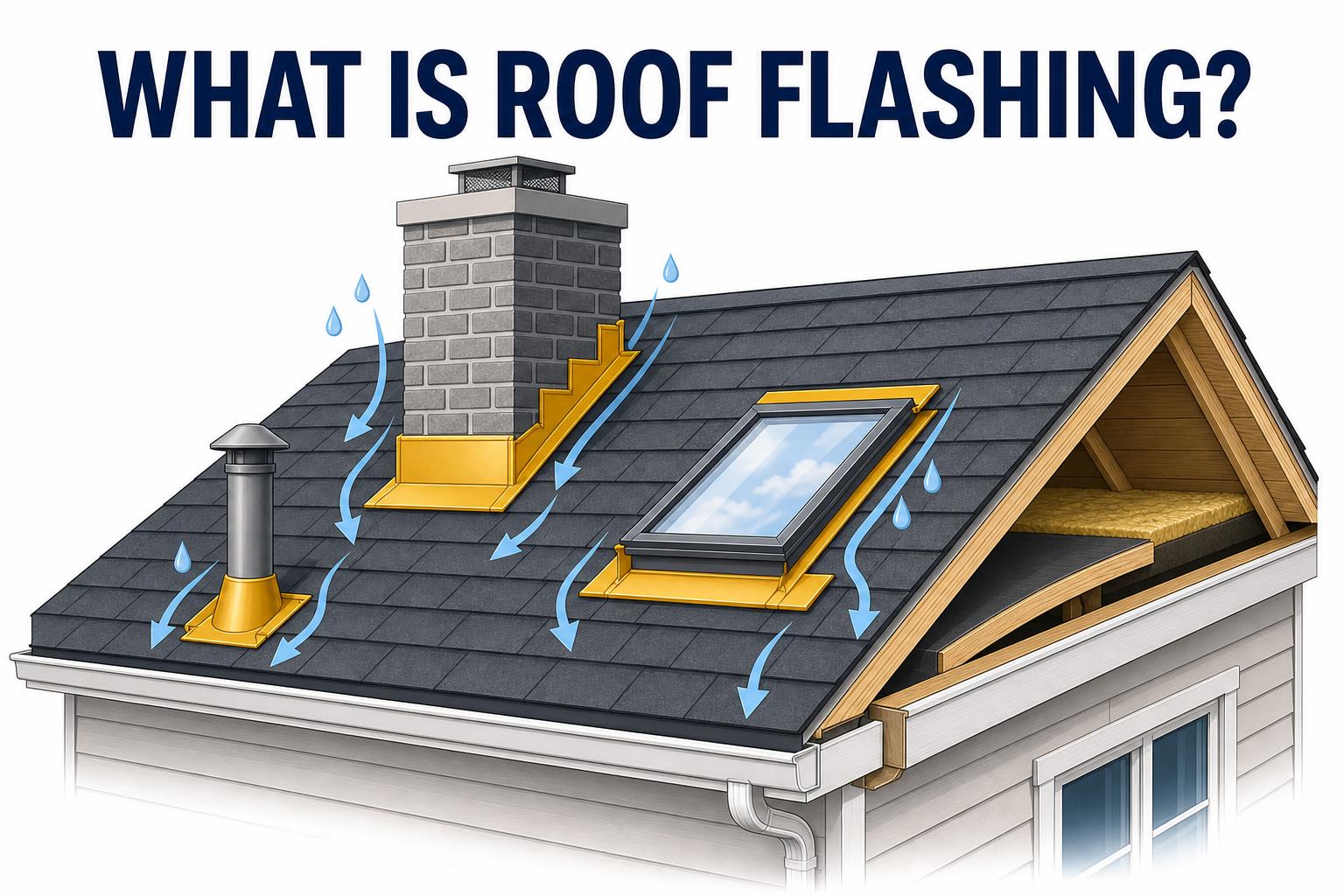
Roof flashing is thin metal sheeting installed wherever your roof has a joint, an edge, or a penetration. Its only job is to move water away from those spots and keep it from seeping into your home.
Anytime two surfaces meet on a roof, or anytime something pokes up through it, there’s a gap. Flashing closes that gap.
It’s usually made from one of these materials:
- Galvanized steel — Tough, affordable, handles Pennsylvania winters well
- Aluminum — Lightweight and common on residential roofs
- Copper — Premium option, long lifespan, common on older Main Line and Chester County homes
- Lead — Rarely used in new construction, but still found on older properties
Which material is right depends on your roof type, your budget, and what’s already on the house.
Where Does Flashing Actually Go?
It’s not just one piece of metal in one spot. Flashing shows up in several places, and each type has a different name and function.
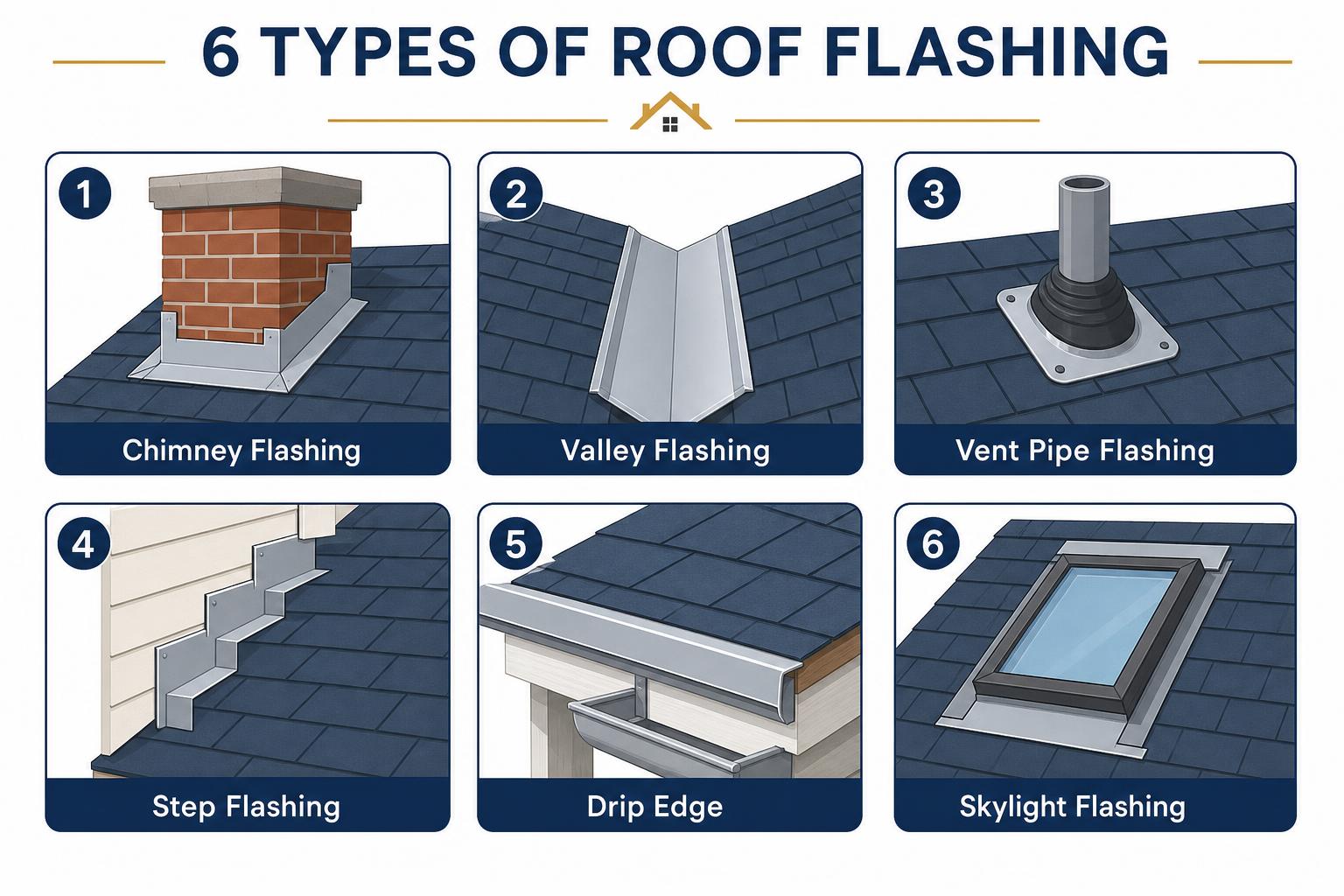
Chimney Flashing
The chimney is the most common place flashing fails. It’s large, it’s heavy, and it sits right in the middle of everything rain and snow hits first. Two pieces work together here: base flashing at the bottom and step flashing along the sides, layered in with the shingles.
Valley Flashing
Where two roof slopes meet, you get a valley. That channel funnels a lot of water, especially during the kind of storms we see in Delco and Montco. Valley flashing lines that channel so water moves off clean instead of working its way underneath. The pitch of your roof affects how fast that water drains, which is why proper valley flashing matters even more on lower-slope homes.
Vent Pipe Flashing
Every plumbing vent and exhaust stack that comes through your roof needs a collar around it. These are called pipe boots. The rubber seal on them dries out over time and cracks, which makes them one of the more common sources of a slow, quiet leak.
Step Flashing
When a roof slope meets a vertical wall, like at a dormer or a home addition, step flashing handles the transition. These are small L-shaped pieces layered in with each course of shingles. Done right, they’re nearly watertight. Done wrong, they’re a problem waiting to happen.
Counter Flashing
This goes over the base flashing, usually pressed into the mortar of a chimney or set into a wall. It covers the top edge of the base flashing and stops water from sneaking behind it. You’ll sometimes see roofers skip this and just caulk over the base flashing instead. That’s a shortcut you’ll notice in a few years.
Drip Edge Flashing
Installed along the eaves and rakes at the edge of your roof, drip edge guides water into your gutters and off the fascia board. It also protects the wood decking at the roof’s edge from rot.
Skylight Flashing
Skylights have their own integrated flashing system. Most skylight leaks aren’t the glass at all. They trace back to flashing that failed or was never installed correctly in the first place.
Why Does Flashing Fail?
Even good flashing doesn’t last forever. In the Philadelphia suburbs, freeze-thaw cycles, ice dams, and heavy spring rain all take a toll over time.
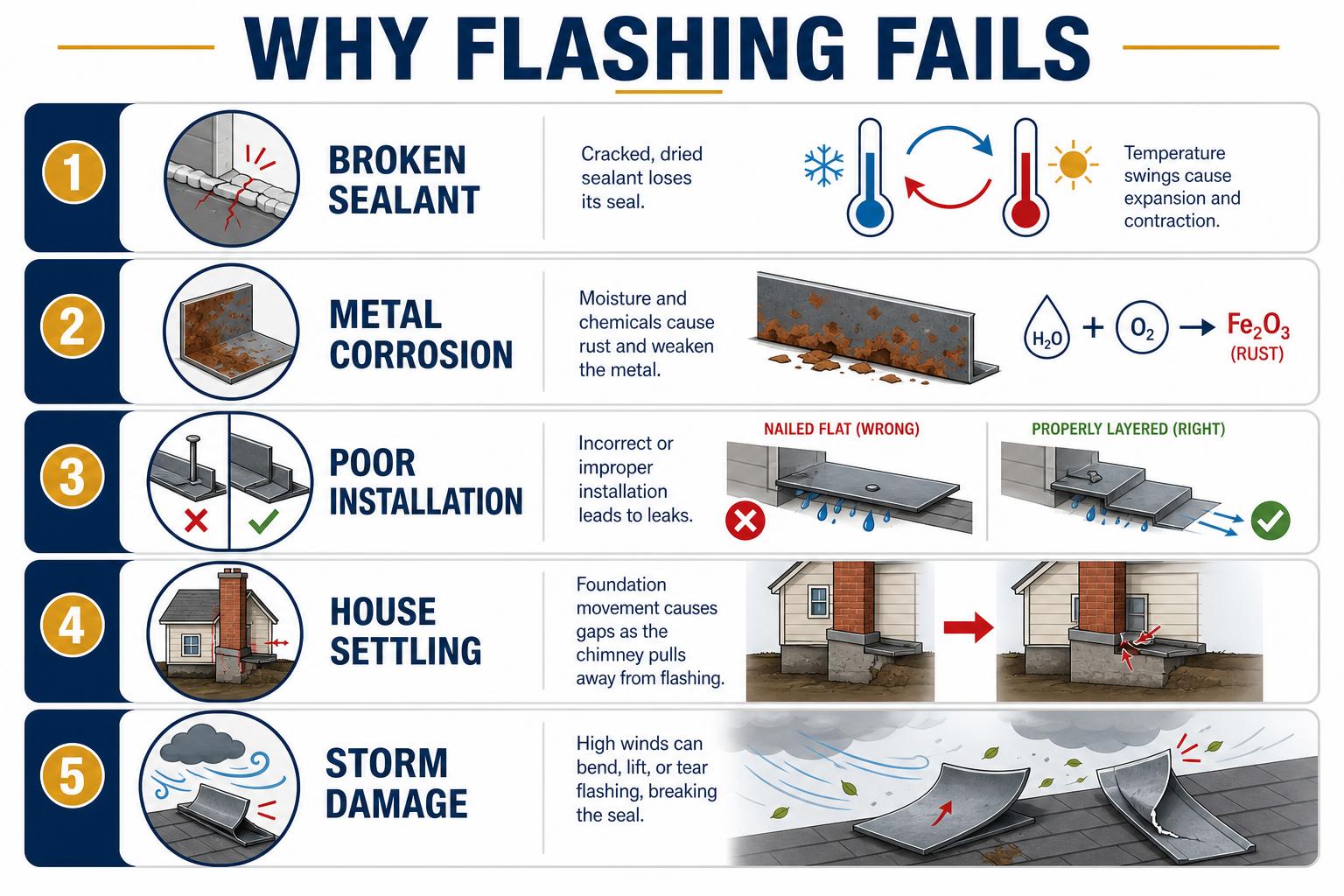
Here’s what typically goes wrong:
- The sealant breaks down. Roofing cement and caulk dry out, especially with temperature swings from January to July.
- The metal corrodes. Cheaper materials rust. Mixing incompatible metals can also cause a chemical reaction that eats through the flashing over time.
- It was installed poorly. Flashing that was surface-sealed instead of properly integrated won’t last. Neither will flashing that was nailed flat instead of layered with the shingles.
- The house has settled. Homes shift. Chimneys can settle slightly. Flashing that was snug at installation can pull away over years.
- Storm damage. High winds bend and lift flashing. Heavy debris can knock pieces loose.
Signs Your Flashing Might Be Failing
You probably won’t see the flashing itself from the street. But you’ll often notice the signs before you ever get a ladder out.
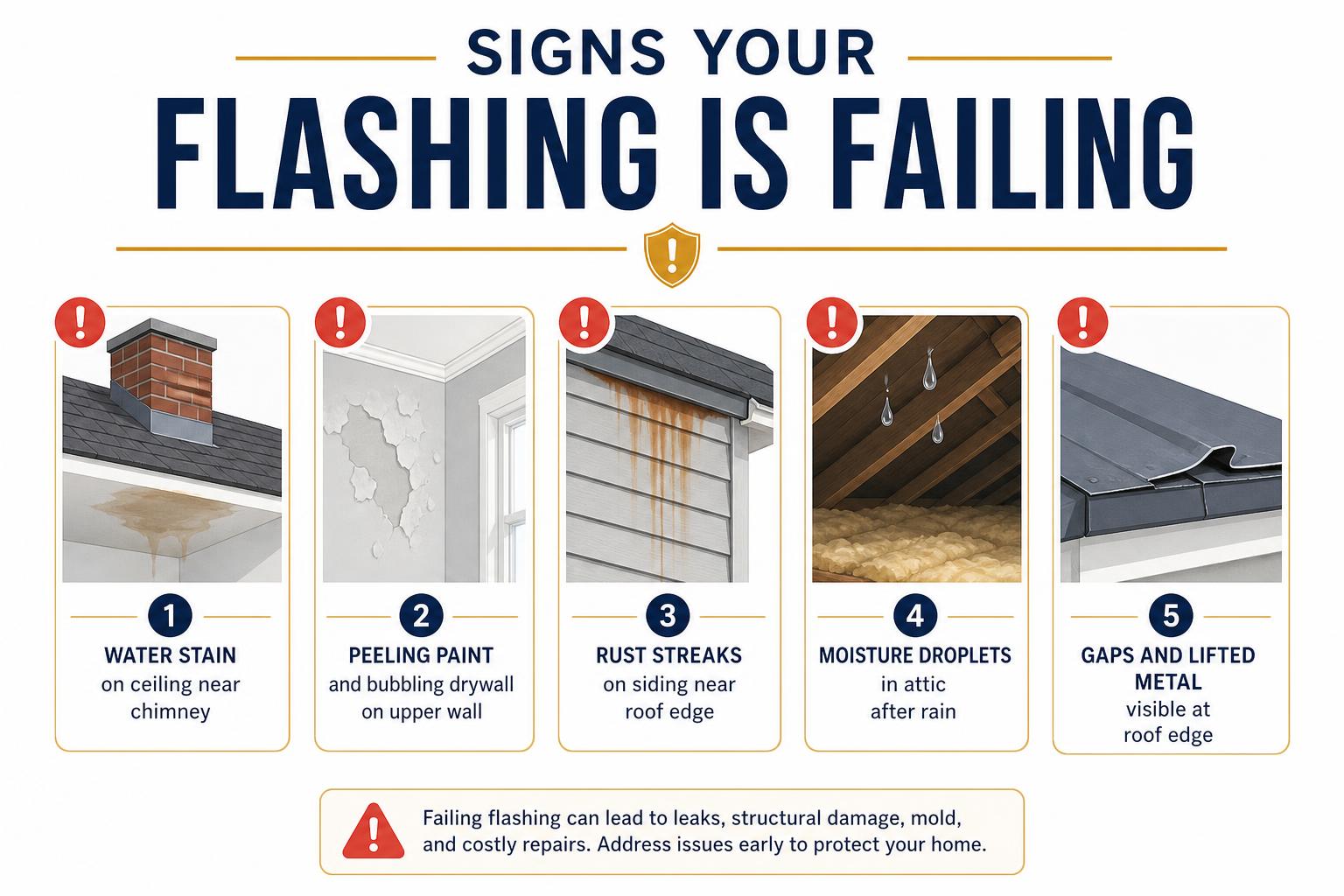
Look for:
- Water stains on ceilings near a chimney, skylight, or exterior wall
- Peeling paint or bubbling drywall in an upper-floor room
- Rust streaks on siding or on the roof surface near a transition
- Attic moisture after rain, even when the shingles look fine
- Visible gaps, rust, or lifting metal near roof edges
Any of these is worth a call to a roofer. Catching a flashing issue early almost always means a targeted repair rather than a much bigger project. If you’re weighing how serious the damage is, our guide on when to repair vs. replace your roof can help you think it through.
Planning a Roof Repair or Replacement?
Use our calculator to get a helpful starting range, then schedule a local inspection for an exact recommendation.
Use the Roofing Cost CalculatorDo You Need a New Roof, or Just New Flashing?
This is a question worth asking carefully.
If your shingles are in decent shape but water is getting in at a chimney or wall transition, you likely do not need a full tear-off. A focused flashing repair can solve the problem at a fraction of the cost.
A good roofer can replace a section of step flashing, re-do chimney flashing, swap out a failed pipe boot, or add drip edge without touching the rest of the roof.
Around the Main Line and Delaware County, chimney flashing repairs typically run somewhere between $300 and $1,200 depending on the scope. Larger jobs, like full chimney re-flashing or skylight flashing replacement, can go higher.
If a contractor tells you the whole roof needs to come off because of a flashing issue, get a second opinion. And if you do end up moving forward with a full replacement, it’s worth reading up on the best time of year to schedule that work so the project goes smoothly.
Flashing vs. Waterproofing Membrane
These two things work together but they’re not the same.
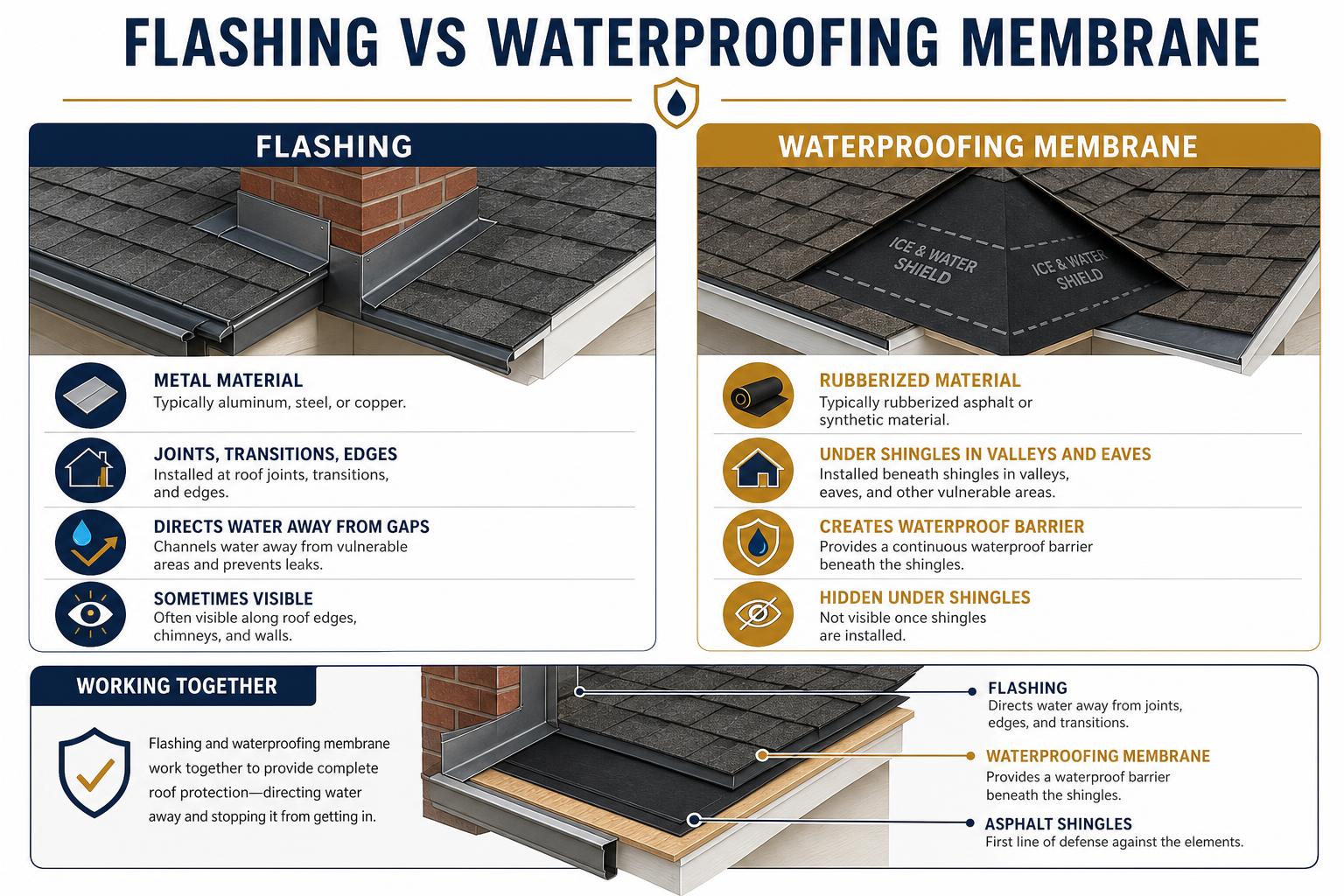
| Flashing | Waterproofing Membrane | |
|---|---|---|
| What it is | Metal sheeting | Rubberized asphalt or synthetic material |
| Where it goes | Joints, transitions, edges | Under shingles in valleys and along eaves |
| What it does | Directs water away from gaps | Creates a waterproof layer beneath shingles |
| Visible? | Sometimes, at edges | Hidden under shingles |
A properly built roof uses both. Ice and water shield goes down first in the valleys and along the eaves. Flashing goes at every penetration and transition point. They give the roof layered protection instead of relying on any single system. On low-slope sections, some homes also use a single-ply membrane roofing system in place of shingles entirely, which changes how flashing integrates with the rest of the roof.
How Long Does Flashing Last?
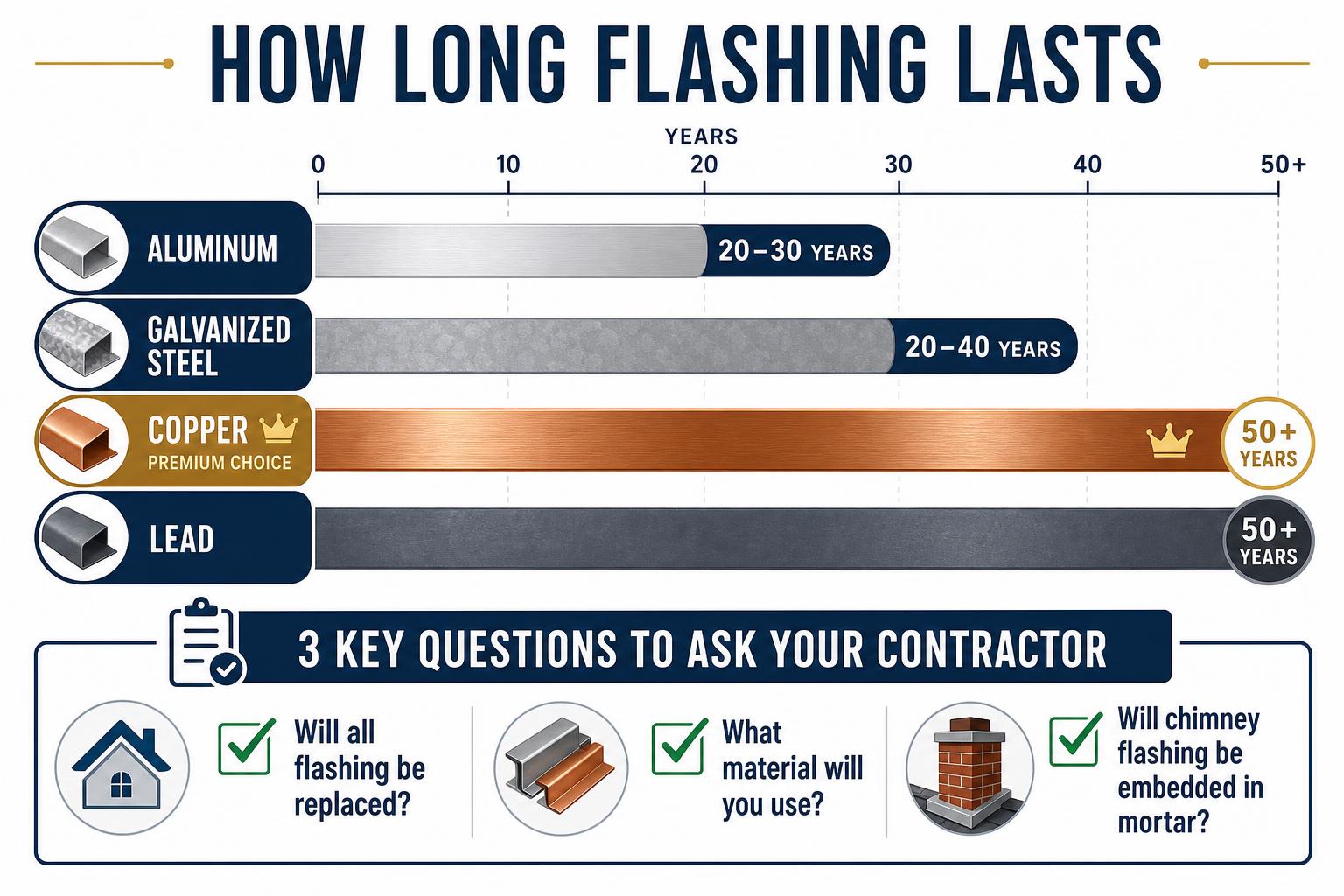
Material matters here.
- Aluminum — 20 to 30 years under normal conditions
- Galvanized steel — 20 to 40 years
- Copper — 50 years or more, often outlasting the roof itself
- Lead — Similar longevity to copper, rarely used in new work
The catch is that sealants often fail before the metal does. A roofer who re-seals your flashing during a routine inspection can buy you years before a full replacement becomes necessary.
What to Ask When Getting a New Roof
When a contractor replaces your roof, new flashing should be part of the job. But not every roofer automatically replaces all of it.
Ask these questions upfront:
- Will all the flashing be replaced, or only the damaged sections?
- What material are you using for the new flashing?
- Will the chimney flashing be embedded into the mortar, or just surface-sealed with caulk?
That last one matters. Surface-sealing alone is faster and cheaper for the contractor. It will hold for a few years, then fail. Properly integrated step and counter flashing is the right way to do it.
Once you’ve booked the job, you might wonder whether you need to stay home during the roof replacement. Short answer: you don’t have to, but there are good reasons to be available.
FAQs About Roof Flashing
How do I know if my chimney flashing needs replacing?
The clearest sign is water getting into the house near the chimney, especially after rain or when snow melts fast. From a ladder, you might also see rust, gaps in the metal, or dried-out sealant that’s pulling away from the brick.
Can I fix roof flashing myself?
For a small crack or dried-out sealant, roofing cement or flashing tape can work as a short-term patch. But if the flashing is corroded, pulling away, or improperly installed to begin with, a professional repair is the right move.
Is copper flashing worth the extra money?
For an older home on the Main Line or in Chester County, copper is a strong choice. It weathers beautifully, lasts for decades, and fits the look of older architecture. For a newer suburban home with standard shingles, galvanized or aluminum does the job at a lower cost.
Does a flashing repair require a permit in Pennsylvania?
A standalone repair usually doesn’t. A full roof replacement may, depending on your township. Your roofer should know what’s required in Delaware, Montgomery, and Chester Counties.
Why is my roof leaking when the shingles look fine?
Because shingles aren’t the only barrier keeping water out. Failed flashing at a chimney, skylight, or wall transition can let water in even when everything else looks intact. This is one of the more common and misunderstood causes of a leak.
More Helpful Roofing Guides from Mainline Roofing Pros
Serving homeowners across the Main Line, Delaware County, Montgomery County, and Chester County.
Bottom Line
Flashing doesn’t get talked about much, but it’s doing real work every time it rains. When it fails, water finds the path of least resistance into your home, and the damage tends to compound quietly before you notice it.
If you’ve got a stain, a drip, or just haven’t had your roof looked at in a while, a basic inspection is a good place to start. You might find a $400 flashing repair before it turns into a $4,000 water damage problem.
Mainline Roofing Pros works with homeowners across the Main Line, Delaware County, Montgomery County, and Chester County. If something looks off or you just want an honest assessment, give us a call. We’ll tell you what we see, straight.
Need Help With Roof Flashing?
Mainline Roofing Pros can inspect your flashing, shingles, ventilation, and attic conditions anywhere across the Main Line, Delco, Montco, and Chester County.

Founder & Owner of Main Line Roofing Pros. 22+ years of local roofing expertise serving Main Line, Delco, Montco & Chesco homeowners with honest, high-quality work.
One thought on “What Is Roof Flashing? Why It’s Critical for Preventing Leaks”