
Financing a New Roof: Options, Costs & What to Watch Out For
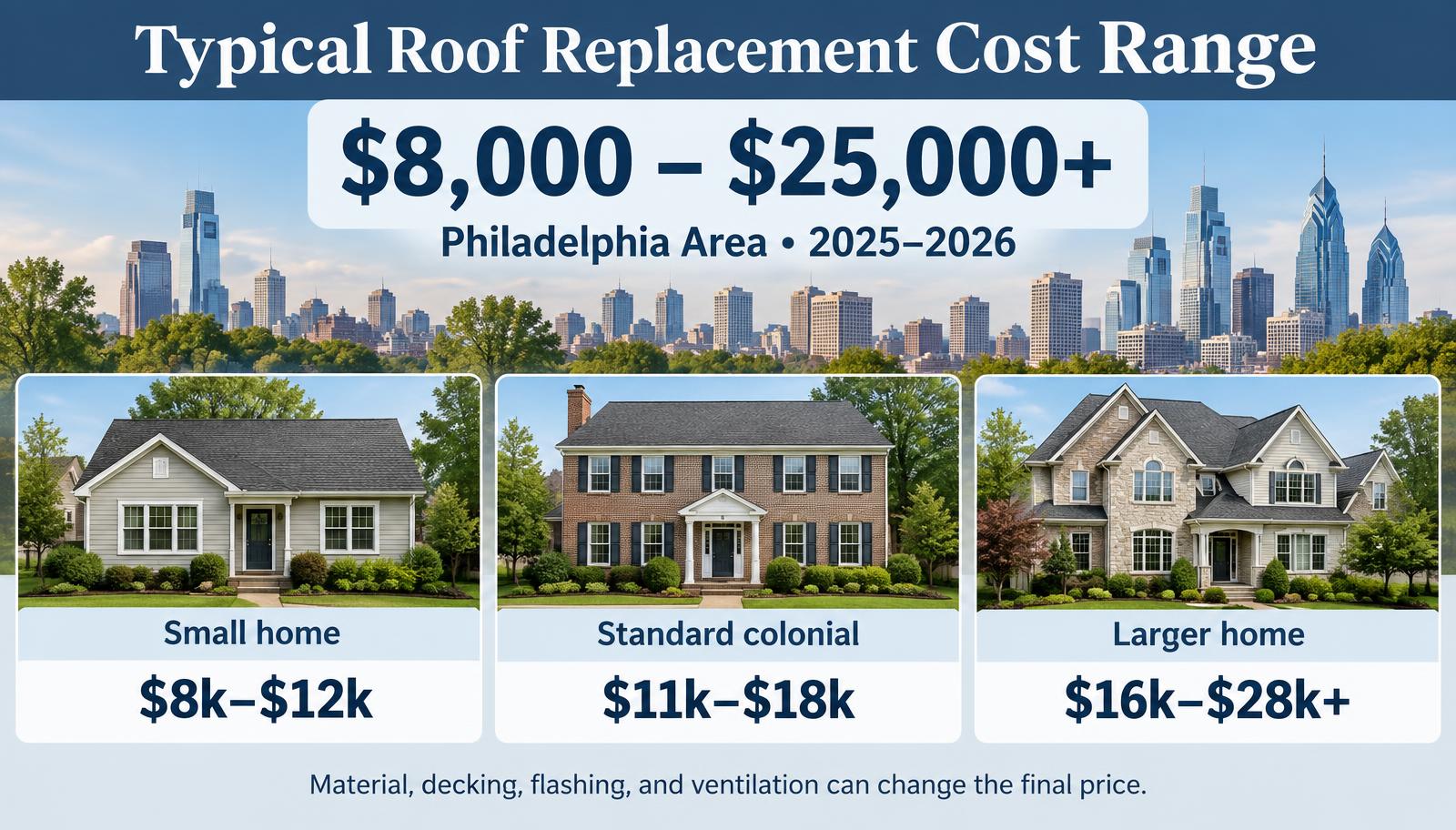
A new roof is not a small purchase. Depending on the size of your home, the material you choose, and what the inspection reveals under the old shingles, a full replacement in the Philadelphia area commonly runs anywhere from $8,000 to $25,000 or more.
Most homeowners do not have that sitting in a savings account. The good news is you do not need to. There are several solid ways to finance a new roof, and understanding how each one works helps you choose the right path for your situation rather than just taking the first offer a contractor puts in front of you.
This guide covers every realistic financing option for a roof replacement, what each one costs you over time, what to watch out for, and how to think through the decision clearly.
Why Roof Financing Is Common
Roofs fail on their own schedule, not yours. Most homeowners find out they need a new roof after a leak shows up, after a storm inspection, or after a home sale inspection flags it as a problem. It is rarely a planned expense with years of saving behind it.
At the same time, delaying a necessary roof replacement is almost always more expensive than financing it. A failing roof that leaks for another season causes water damage to insulation, sheathing, framing, drywall, and interior finishes. The cost of that damage typically exceeds the cost of financing the roof itself many times over.
Financing a roof is a practical decision, not a financial failure. Most people finance cars, appliances, and home improvements without a second thought. A roof is no different — it is a long-term asset that protects everything inside your home.
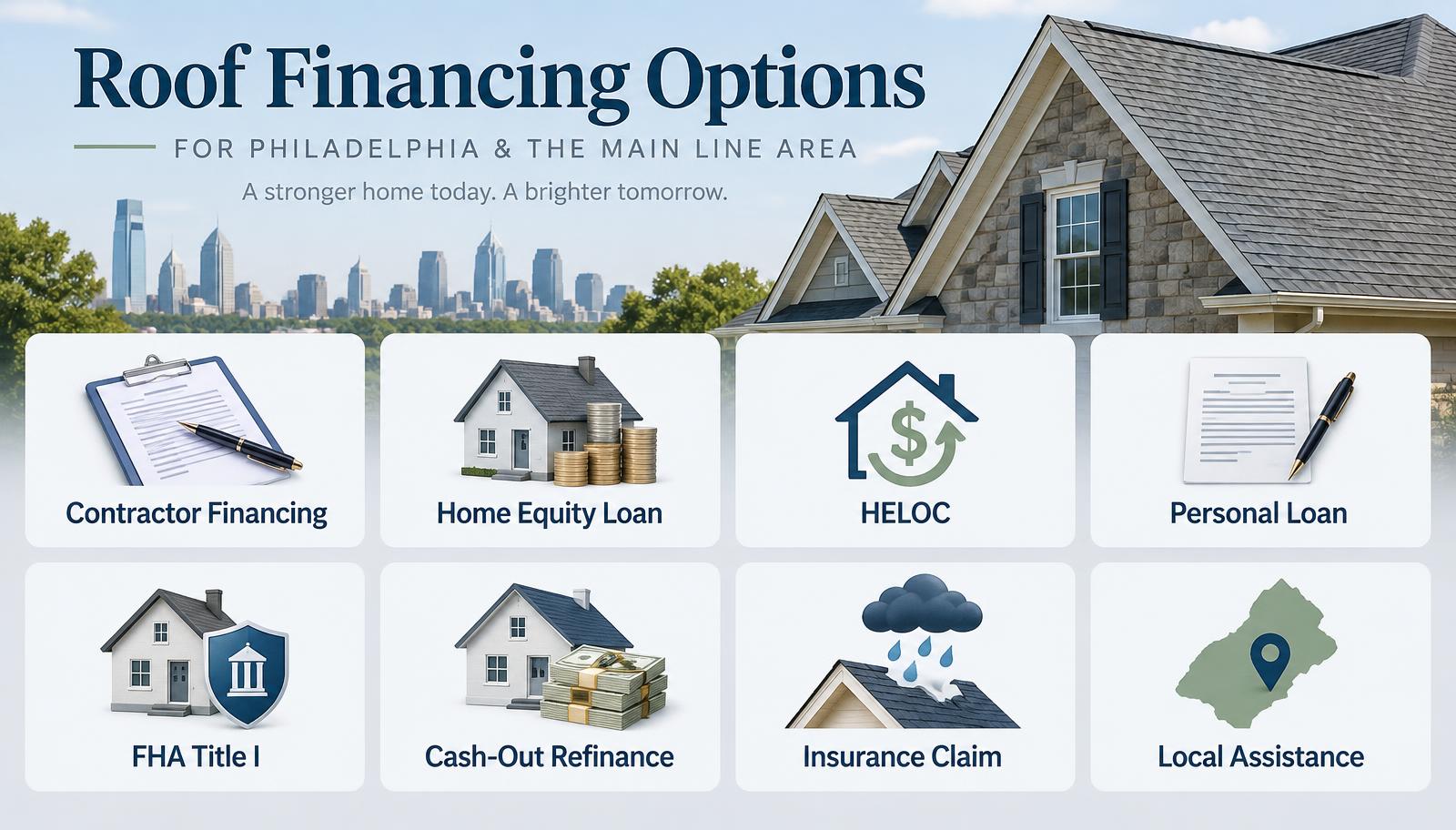
Your Financing Options
1. Contractor Financing
Many roofing contractors offer financing directly through a lending partner. You apply at the time of your estimate, get approved quickly (sometimes within minutes), and the contractor gets paid in full while you pay monthly installments to the lender.
Common programs include:
- 12 to 18 month same-as-cash or deferred interest promotions
- Fixed-rate installment loans ranging from 6 to 15 percent APR
- Terms from 12 months up to 10 or 12 years
The appeal is convenience. One application, approved on the spot, work starts immediately. The risk is that deferred interest promotions can be expensive if you do not pay off the balance before the promotional period ends. If you carry a balance past the promotional date, the lender often back-charges interest for the entire promotional period at a high rate, sometimes 25 to 30 percent.
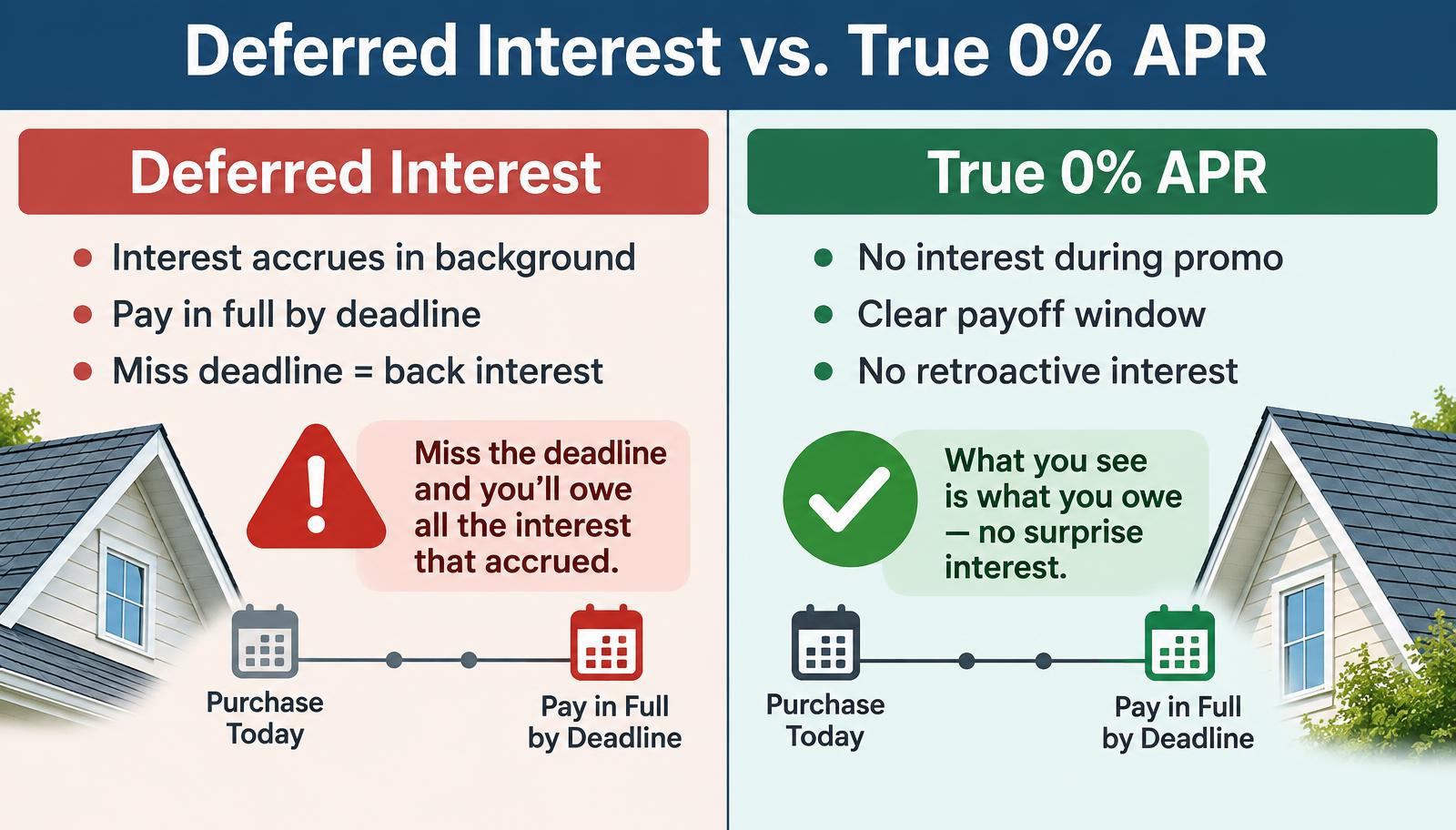
Key question to ask: Is this deferred interest or true 0% APR? Deferred interest means you owe back interest if you do not pay in full by the deadline. True 0% APR means no interest accrues at all during the promotional period.
2. Home Equity Loan
A home equity loan lets you borrow against the value you have built up in your home. You receive a lump sum and repay it at a fixed interest rate over a set term, typically 5 to 15 years.
- Interest rates are generally lower than personal loans or contractor financing
- Interest may be tax deductible if the funds are used for home improvements
- Fixed monthly payments make budgeting straightforward
- Requires equity in your home and a lender approval process
- Your home is collateral, so missed payments have serious consequences
For homeowners in Bryn Mawr, Villanova, Wayne, and across the Main Line where home values are strong, a home equity loan is often the lowest-cost financing option available. The rate is typically well below what you would get from a personal loan or contractor financing program.
3. Home Equity Line of Credit (HELOC)
A HELOC works like a credit card secured by your home’s equity. You are approved for a credit limit and draw from it as needed during a draw period, typically 5 to 10 years. After the draw period ends, you repay what you borrowed.
- Flexible — borrow only what you need
- Interest rates are variable, which means payments can change over time
- Good option if you have multiple home improvement projects planned
- Same equity and approval requirements as a home equity loan
- Your home is collateral
A HELOC makes the most sense when the roof is one of several projects you plan to tackle. If you are only financing the roof, a home equity loan with a fixed rate is usually cleaner.
4. Personal Loan
A personal loan is an unsecured installment loan from a bank, credit union, or online lender. You do not need home equity and your home is not collateral. Terms typically range from 2 to 7 years.
- No home equity required
- Your home is not at risk if you miss payments
- Approval based primarily on credit score and income
- Rates vary widely — good credit borrowers may see 7 to 12 percent APR; lower credit scores may see 15 to 25 percent or higher
- Faster funding than home equity products in many cases
Personal loans are a reasonable option for homeowners who lack significant equity or who want to keep the transaction separate from their home. The trade-off is a higher interest rate than a home equity product.
5. FHA Title I Home Improvement Loan
The FHA Title I program allows homeowners to borrow up to $25,000 for home improvements including roof replacement without requiring home equity. The loan is government-backed, which allows lenders to offer it to borrowers who would not qualify for conventional home equity products.
- Available to homeowners without significant equity
- Loan amounts up to $25,000 for single-family homes
- Fixed interest rates, typically competitive with personal loan rates
- Must be used for improvements that protect or improve the livability of the property
- Requires working with an FHA-approved lender
This is worth looking into if you have limited equity but need a full roof replacement and want a structured government-backed loan rather than a high-rate personal loan or contractor financing.
6. Cash-Out Refinance
If mortgage rates are favorable and you have significant equity, a cash-out refinance lets you replace your existing mortgage with a new, larger one and take the difference as cash. You could use that cash to pay for the roof outright.
- Potentially the lowest interest rate of any option if you refinance at a good rate
- Resets your mortgage term, which extends the total repayment period
- Closing costs apply, typically 2 to 5 percent of the loan amount
- Only makes sense when the new mortgage rate is at or below your current rate
- Not practical in a high-rate environment if your current mortgage rate is lower
In the current rate environment, cash-out refinancing is worth calculating carefully. If your current mortgage rate is lower than what you would get today, the math usually does not favor refinancing just for a roof.
7. Homeowners Insurance
If your roof was damaged by a covered event — hail, wind, a fallen tree — your homeowners insurance policy may cover part or all of the replacement cost. This is not financing in the traditional sense, but it is worth addressing here because many homeowners do not pursue it when they should.
- Covers sudden, accidental damage from named perils (hail, wind, fire, falling objects)
- Does not cover normal wear, age-related deterioration, or maintenance neglect
- Actual Cash Value (ACV) policies pay replacement cost minus depreciation
- Replacement Cost Value (RCV) policies pay the full cost to replace with comparable material
- Your deductible applies before the insurer pays anything
After any significant storm in the Philadelphia area, it is worth having your roof inspected for damage before assuming insurance does not apply. Hail damage in particular is not always visible from the ground. A documented inspection creates the record you need to file a legitimate claim.
8. Pennsylvania and Local Assistance Programs
Several programs exist for homeowners who qualify based on income or circumstances.
- PHFA (Pennsylvania Housing Finance Agency) — offers home improvement loan programs for qualifying homeowners, including the Keystone Home Loan and HEELP programs
- USDA Section 504 Home Repair program — for very low-income rural homeowners; provides loans and grants for critical repairs including roofing
- Local community development programs — Delaware County, Montgomery County, and Chester County each have community development offices that administer grant and loan programs for home repair
- Weatherization Assistance Program — federally funded, helps income-qualifying homeowners with home improvements that improve energy efficiency, which can include roof-related work
These programs are income-based and have eligibility requirements, but for homeowners who qualify they represent real money that does not need to be repaid in some cases.
Ready to Get a Roof Estimate?
Knowing the real cost is the first step to choosing the right financing option. Mainline Roofing Pros provides clear estimates for homes across the Main Line, Delco, Montco, and Chester County.
Comparing Your Options Side by Side
| Option | Typical Rate | Home Equity Required | Best For |
|---|---|---|---|
| Contractor financing (promo) | 0% promo / 25%+ if not paid off | No | Homeowners who can pay off in 12 to 18 months |
| Contractor financing (fixed) | 6% to 15% APR | No | Quick approval with no equity needed |
| Home equity loan | 6% to 10% APR | Yes | Homeowners with equity wanting lowest fixed rate |
| HELOC | Variable, often 7% to 11% | Yes | Multiple projects, flexible draw needs |
| Personal loan | 7% to 25%+ APR | No | No equity, home not at risk |
| FHA Title I | Competitive fixed rate | No | Limited equity, structured government loan |
| Cash-out refinance | Current mortgage rates | Yes | Large projects when refinance rate is favorable |
| Insurance claim | N/A (deductible applies) | No | Storm or sudden damage from covered perils |
What to Watch Out For
A few things that catch homeowners off guard when financing a roof.
Deferred Interest vs. True 0% APR
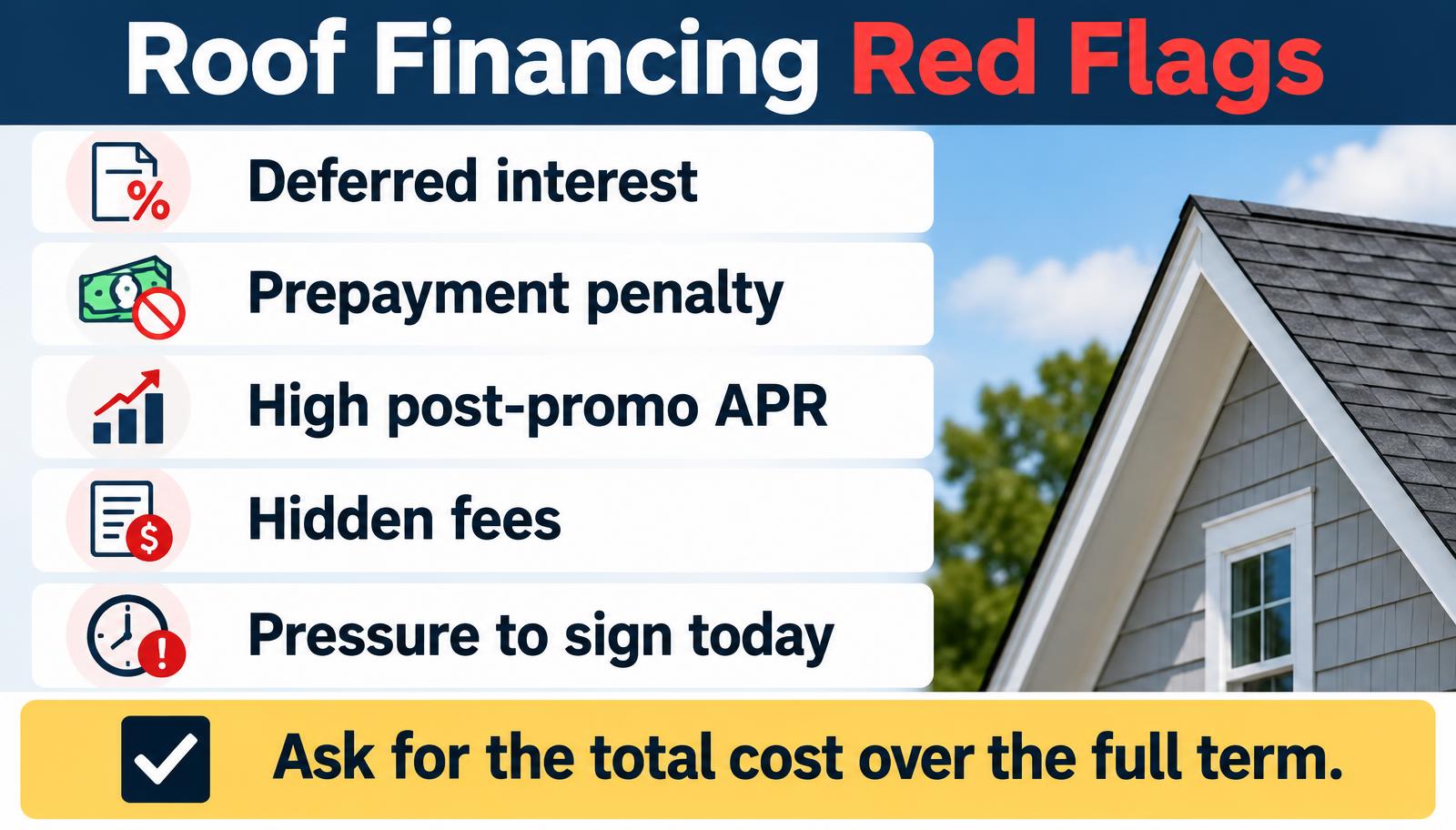
This distinction is critical and contractors do not always make it clear. A true 0% APR promotion means no interest accrues during the promotional period. Deferred interest means the interest accrues the entire time but is waived if you pay the full balance by the deadline. Miss that deadline by a single day and the full accrued interest — often at 26 to 29 percent — gets added to your balance.
If a contractor promotes 18 months same as cash, read the agreement carefully before signing. If it says “deferred interest,” plan to pay it off well before the deadline or consider a different financing option.
Prepayment Penalties
Some personal loans and contractor financing programs charge a fee if you pay the loan off early. Check for this before committing. If you plan to pay the loan off faster than the term, a prepayment penalty can eliminate the savings.
Insurance Depreciation
If your policy pays actual cash value rather than replacement cost value, your insurance payout will be reduced by depreciation. A 20-year-old roof may be depreciated to a fraction of its replacement cost, leaving you responsible for a larger out-of-pocket gap than you expected. Know what type of policy you have before you file.
Contractor Financing Tied to a Single Contractor
When a contractor arranges financing for you, it can create pressure to commit to that contractor before you have gotten other estimates. Get your estimates first. Once you know what you want to spend and with whom, then explore financing. You can always apply for contractor financing at the end of the process.
How Much Does a Roof Replacement Cost in the Philadelphia Area?
Knowing the realistic cost range helps you figure out how much you actually need to finance. Here are ballpark figures for the Main Line and surrounding suburbs in 2025 and 2026.
| Home Size / Type | Asphalt Shingles | Cedar / Synthetic Slate | Natural Slate |
|---|---|---|---|
| Small Cape Cod or twin (12 to 16 squares) | $8,000 to $12,000 | $14,000 to $22,000 | $22,000 to $38,000 |
| Standard Colonial (18 to 26 squares) | $11,000 to $18,000 | $20,000 to $35,000 | $35,000 to $60,000+ |
| Larger home with dormers (26 to 40+ squares) | $16,000 to $28,000 | $30,000 to $55,000 | $55,000 to $100,000+ |
These ranges include materials, labor, tear-off, basic flashing replacement, and disposal. Deck replacement if rot is found, upgraded ventilation, and specialty flashing details all add cost. For a more precise estimate on your specific home, our roofing cost calculator gives you a useful starting range.
Questions to Ask Before You Sign Anything
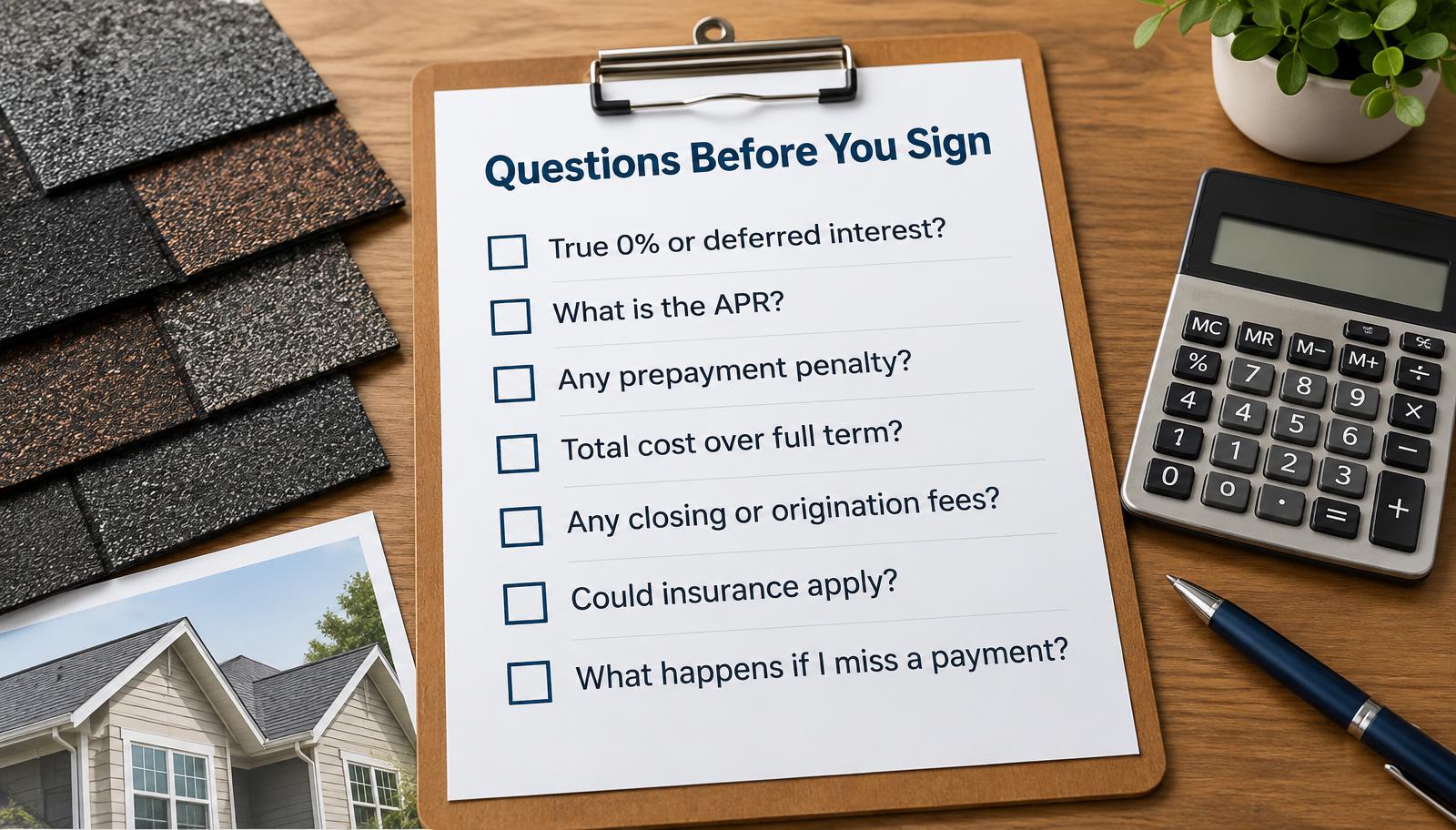
Whether you are financing through a contractor or applying independently, ask these before you commit:
- Is this deferred interest or true 0% APR?
- What is the interest rate after the promotional period ends?
- Is there a prepayment penalty?
- What is the total cost of the loan over the full term?
- Does my homeowners insurance cover any portion of this replacement?
- Is the interest tax deductible if I use a home equity product?
- What happens if I miss a payment?
- Are there origination fees or closing costs I am not seeing in the monthly payment?
FAQs About Financing a New Roof
Can I finance a new roof with bad credit?
Yes, though your options narrow and costs go up. Contractor financing programs through roofing companies often have more flexible credit requirements than banks. FHA Title I loans are also accessible to borrowers without strong credit or home equity. Personal loans from online lenders work on a spectrum where lower credit scores result in higher interest rates rather than flat denials. If your credit is poor, compare several options and look carefully at the total cost over the loan term, not just the monthly payment.
Does financing a roof hurt your credit score?
Applying for any loan creates a hard inquiry on your credit report, which can temporarily lower your score by a few points. Taking on new debt also affects your debt-to-income ratio and credit utilization. However, consistently making on-time payments on a roof loan will build your credit over time. The short-term dip from a hard inquiry is minor and typically recovers within a few months.
Is roof financing a good idea?
It depends on your alternative. If the choice is between financing a roof now and delaying a replacement that is actively leaking, financing is almost certainly the better financial decision. Water damage compounds. Framing rot, mold, insulation loss, and interior damage from a leaking roof cost far more to address than the interest on a roof loan. If you are financing to avoid spending cash you have, consider whether the interest cost is worth preserving your liquidity for other uses.
Can I use a home equity loan to pay for a roof?
Yes, and it is one of the most cost-effective ways to finance a roof replacement. Home equity loans offer lower interest rates than personal loans or contractor financing, and the interest may be tax deductible when used for home improvements. You need sufficient equity in your home and will go through a lender’s approval process, which takes more time than contractor financing but often costs significantly less over the life of the loan.
Will my homeowners insurance pay for a new roof?
Only if the damage was caused by a covered peril, most commonly wind, hail, fire, or falling objects. Normal aging and wear are not covered. If you had a storm recently and have not had your roof inspected, it is worth scheduling an inspection before assuming insurance does not apply. Hail damage in particular is not always visible from the ground but can be documented by a roofing professional. Know whether your policy pays actual cash value or replacement cost value — the difference can be substantial on an older roof.
What credit score do I need to finance a roof?
It depends on the financing type. Home equity loans typically require a credit score of 620 or higher, with better rates for scores above 700. Personal loans are available across a wide range of credit scores but rates increase significantly below 650. Contractor financing programs through roofing companies vary by lender but many approve scores in the 580 to 620 range. FHA Title I loans are accessible to borrowers who would not qualify for conventional products.
How long does roof financing take to get approved?
Contractor financing is typically the fastest, with approvals in minutes at the time of your estimate. Personal loans from online lenders often fund within one to three business days. Home equity loans take longer, typically two to four weeks for approval and funding. FHA Title I loans have a longer process as well. If your roof is actively leaking and needs immediate attention, contractor financing or a personal loan are the fastest paths to getting work started.
Is roof replacement tax deductible?
Generally, a roof replacement on your primary residence is not directly tax deductible as a home improvement expense. However, it adds to your home’s cost basis, which can reduce capital gains tax when you sell. If you use a home equity loan or HELOC and the funds are used for the improvement, the interest may be deductible. If the property is a rental, roof replacement is deductible as a business expense. Consult a tax professional for guidance specific to your situation.
More Helpful Roofing Guides from Mainline Roofing Pros
Serving homeowners across the Main Line, Delaware County, Montgomery County, and Chester County.
Bottom Line
There is no single best way to finance a roof. The right option depends on your equity, your credit, how quickly you need the work done, and how much you want to minimize interest cost over time.
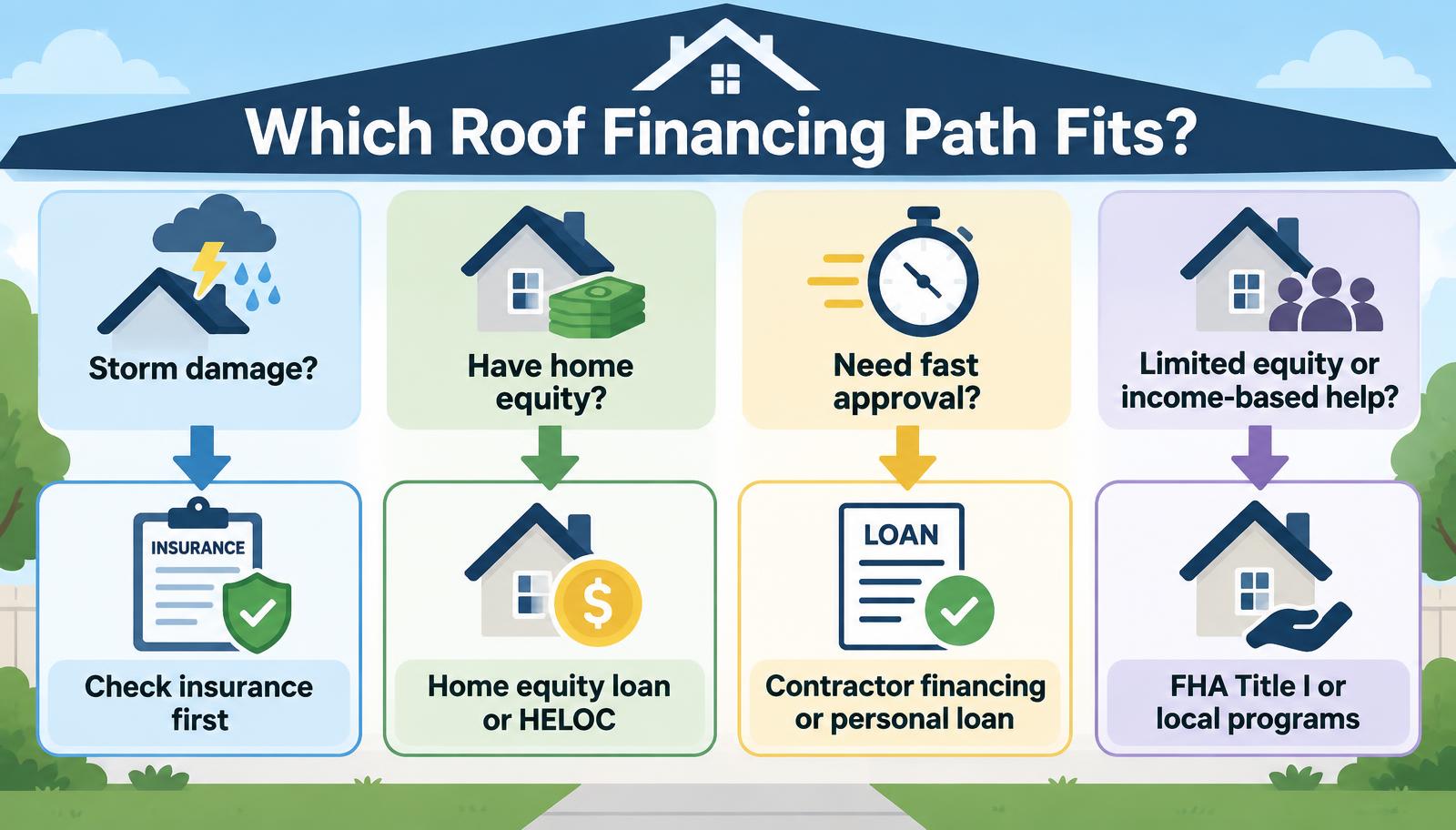
For most homeowners on the Main Line and across the Philadelphia suburbs, the pecking order looks like this: insurance first if damage is covered, home equity loan or HELOC if you have equity and can wait a few weeks, contractor financing if you need to move fast and can pay it off in the promotional window, personal loan if you need speed without equity, and government programs if you qualify.
What you should not do is delay a roof that genuinely needs replacing because financing feels complicated. The cost of water damage inside your home will dwarf the cost of a loan.
Mainline Roofing Pros provides honest estimates for homes across the Main Line, Delaware County, Montgomery County, and Chester County. We do not push financing — we give you a clear number so you can make the right call for your budget. Reach out and we will take a look.
Get a Clear Estimate Before You Decide on Financing
Mainline Roofing Pros serves the Main Line, Delco, Montco, and Chester County. Know your number first — then choose the financing that works for you.
Founder & Owner of Main Line Roofing Pros. 22+ years of local roofing expertise serving Main Line, Delco, Montco & Chesco homeowners with honest, high-quality work.