
Types of Roof Vents: A Homeowner’s Guide
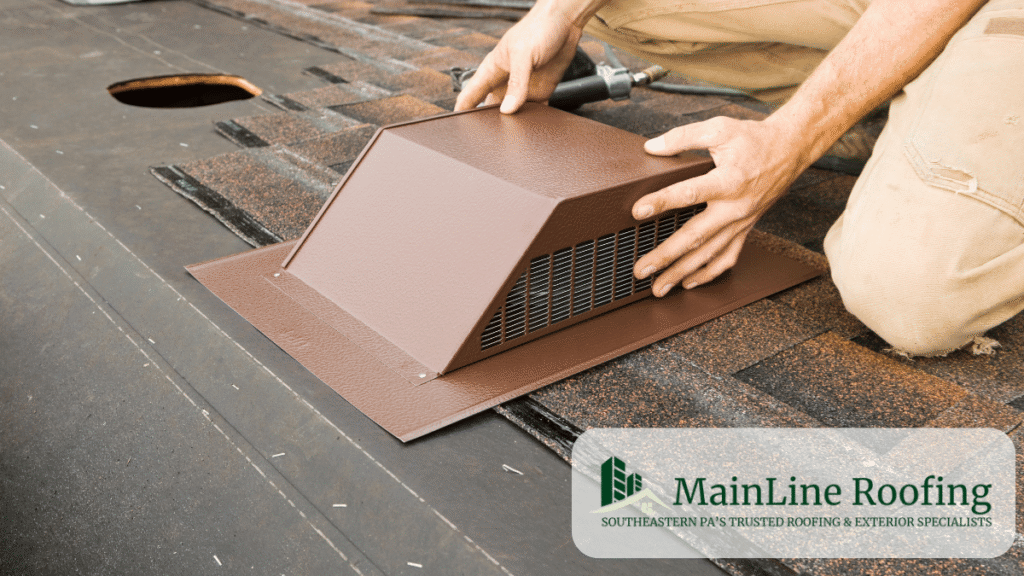
Your roof vents do quiet work every day. In summer, they push hot air out before it bakes your shingles from underneath. In winter, they prevent the moisture buildup that leads to rot, mold, and ice dams. When they are the wrong type or installed incorrectly, the damage shows up years later in ways that look expensive.
Most homeowners across the Main Line, Delaware County, Montgomery County, and Chester County have never thought twice about the vents on their roof. They’re easy to ignore until something goes wrong. This guide covers every type of roof vent in plain language, how each one works, where it belongs, and what to watch for.
By the end, you’ll know what your roof has, what it should have, and what questions to ask the next time a roofer is on your property.
Not Sure What Your Roof Has?
Mainline Roofing Pros inspects attic ventilation as part of every roof assessment. We’ll tell you what you have and whether it’s working.
Why Roof Ventilation Matters
Before getting into vent types, it helps to understand what ventilation is actually doing inside your attic.
Your attic sits between your living space and the outside. In summer, the sun heats your roof surface to temperatures that can exceed 150 degrees. Without proper ventilation, that heat has nowhere to go. It bakes the underside of your shingles, cooking the asphalt and shortening the roof’s life. It also radiates into your living space, making your second floor uncomfortable and your air conditioning work harder.
In winter, the opposite problem develops. Warm, moist air from inside the house rises into the attic. If it can’t escape, it condenses on the cold roof decking. Over time, that moisture causes rot, mold, and structural damage. It also contributes to ice dams, where heat escaping through the roof melts snow that then refreezes at the cold eaves and backs water up under your shingles.
Good ventilation solves both problems by creating a steady flow of outside air through the attic. Cool dry air comes in low, picks up heat and moisture, and exits high. That airflow keeps temperatures and humidity in check year round.
The basic rule: Intake vents go low. Exhaust vents go high. Both are needed. One without the other does not work properly. This is the most common ventilation mistake we see on Main Line homes.
The Two Categories: Intake and Exhaust
Every roof vent falls into one of two categories. Knowing the difference is the foundation of everything else.
Intake vents allow outside air to enter the attic. They are installed low on the roof, typically at the soffits along the eaves, so incoming air can travel upward through the attic space.
Exhaust vents allow hot, moist air to escape the attic. They are installed high on the roof, typically at or near the ridge, so rising hot air has a path out.
A well-ventilated attic uses both. Intake without exhaust creates stagnant air that doesn’t actually move. Exhaust without intake creates negative pressure that can pull conditioned air out of your living space or draw exhaust from combustion appliances back into the house.
Exhaust Vent Types
There are more exhaust vent options than most homeowners realize. Each works differently and has different performance characteristics.
Ridge Vents
A ridge vent runs continuously along the peak of the roof, the full length of the ridge. It is cut into the roof decking just below the cap shingles and covered with a low-profile vent strip that allows air to escape while keeping out rain, insects, and debris.
Ridge vents are the gold standard for exhaust ventilation on pitched residential roofs. Because they run the entire length of the ridge, they provide even ventilation across the whole attic rather than concentrating airflow at a single point. They also sit at the very top of the roof, which is exactly where the hottest air collects.
They are nearly invisible from the street because the cap shingles cover the vent strip. Most homeowners don’t know they have one.
On Main Line homes, ridge vents are the standard recommendation for any new roof installation. If your home does not have one and you’re replacing your roof, adding a continuous ridge vent is almost always the right move.
Pros
- Even ventilation along the full ridge
- Low profile, nearly invisible
- No moving parts to fail
- Works with natural convection
- Compatible with solar vents and intake vents
Cons
- Requires adequate soffit intake to work correctly
- Not suitable for hip roofs without proper hip vent product
- Can be incorrectly installed, reducing effectiveness
Box Vents (Static Vents)
Box vents, also called static vents, louver vents, or turtle vents, are small square or rectangular openings cut into the roof deck near the ridge. They sit low to the roof surface and are covered with a louvered hood that allows air to escape while blocking weather.
They rely on natural convection and wind to move air. Hot air rises, exits through the vent, and wind passing over the opening creates additional draw. They work reasonably well but cover only a small area around each unit. Multiple box vents are needed to ventilate a full attic.
You’ll see box vents on a lot of older homes in Havertown, Drexel Hill, and throughout Delaware County. When we inspect these homes, one of the first things we check is whether there are enough box vents for the attic square footage and whether the soffit intake is adequate to support them.
Pros
- Simple, no moving parts
- Easy to add during a roof replacement
- Inexpensive per unit
- Work on complex roof shapes
Cons
- Limited ventilation area per vent
- Multiple units needed for full coverage
- Less effective than ridge vents on long roofs
- Can allow wind-driven rain if installed improperly
Power Attic Ventilators (PAVs)
Power attic ventilators, also called attic fans or powered roof vents, use an electric or solar-powered fan to actively pull air out of the attic. They are triggered by a thermostat or humidistat and kick on when temperatures or humidity reach a set level.
They move more air faster than passive vents. In theory, that sounds like a good thing. In practice, they create several problems if the attic is not also well sealed from the living space below.
When a power vent creates strong negative pressure in the attic, it can pull conditioned air up through ceiling gaps, recessed lights, attic hatches, and other openings. That means your air conditioning is losing cool air directly into the attic while the fan is running. Some research suggests this can increase cooling costs rather than reduce them.
They can also pull combustion gases from water heaters, furnaces, or fireplaces back into the living space if there are combustion appliances nearby.
That said, PAVs can be useful in specific situations, particularly in attics that are structurally difficult to ventilate passively and where the air barrier between living space and attic is well sealed. A qualified roofer or energy auditor should assess before recommending one.
Pros
- Moves large volumes of air quickly
- Thermostat-controlled, runs when needed
- Solar models have no operating cost
- Can help in difficult-to-ventilate attics
Cons
- Can depressurize attic and pull conditioned air up
- Risk of backdrafting combustion appliances
- Moving parts that can fail
- May increase energy costs if attic is not air-sealed
- Electric models add to energy bills
Turbine Vents (Whirlybirds)
Turbine vents, sometimes called whirlybirds, use a spinning turbine that is turned by wind. As it spins, it draws air upward out of the attic. In still air conditions they act as a passive convection vent. In wind they work actively to pull air out.
They were very common on homes built in the 1970s and 1980s. You’ll still see them on homes in Springfield, Upper Darby, and throughout Delco on that era of housing stock.
The main issue is the moving parts. Bearings wear out. A turbine vent that stops spinning or squeaks on every rotation isn’t ventilating your attic. During a roof inspection, we check whether turbine vents are still spinning freely. Many on older homes are seized and need to be replaced or removed.
Pros
- No electricity needed
- Wind makes them more effective than static vents
- Move more air than box vents in windy conditions
Cons
- Moving parts wear out over time
- Noisy when bearings begin to fail
- Less effective in low-wind conditions
- Can let rain or snow in if they stop spinning during a storm
Gable Vents
Gable vents sit in the triangular gable wall at the end of a house, below the roof peak. They are typically louvered wood or metal openings that allow air to move in or out depending on wind direction.
They are one of the oldest forms of attic ventilation and are found on a large percentage of older Main Line homes, particularly homes in Merion Station, Bryn Mawr, and Haverford that were built before ridge vents became standard.
Here’s where gable vents get complicated. When you have gable vents and a ridge vent on the same roof, wind can blow in through the gable vent and short-circuit the soffit-to-ridge airflow. Air comes in the gable, crosses the upper attic, and exits the ridge, but the lower attic near the soffits never gets ventilated at all. This is called short-circuiting the ventilation system and it’s a common problem on older homes that received a ridge vent upgrade without blocking the gable vents.
When used on their own without ridge vents, gable vents provide cross-ventilation rather than true upward airflow. This is better than nothing, but not as effective as a balanced soffit-and-ridge system.
Pros
- Simple and inexpensive
- Common on older homes, easy to maintain
- Provide cross-ventilation in absence of other vents
- Can be decorative features on historic homes
Cons
- Can short-circuit ridge vent systems
- Cross-ventilation less effective than convective flow
- Depend on wind direction to work well
- Can allow pest entry if screens fail
Intake Vent Types
Intake vents are just as important as exhaust vents, and they’re often the weak link in older homes. Without adequate intake, exhaust vents can’t do their job.
Soffit Vents
Soffit vents are installed in the underside of the roof overhang, the soffit, along the eaves of the house. They allow outside air to enter the attic at the lowest point of the roofline, which sets up the convective flow that carries air up through the attic and out at the ridge.
There are two main types. Individual soffit vents are small rectangular or round openings spaced along the soffit. Continuous soffit vents are a perforated or screened strip that runs the full length of the soffit and provide more uniform airflow.
Continuous soffit venting is the preferred option when installing a new roof or replacing soffits. It pairs naturally with a continuous ridge vent to create the most efficient balanced ventilation system available.
One critical issue: insulation that gets pushed into the eaves can block soffit vents from the inside. This is one of the most common ventilation failures we find in attic inspections. The fix is simple. Rafter baffles, also called insulation baffles or ventilation chutes, are installed at each rafter bay to keep a clear airway between the soffit vent and the open attic space.
Pros
- Ideal intake position at the eaves
- Continuous strip provides even airflow
- Pairs perfectly with ridge vents
- No moving parts
- Low visibility from the ground
Cons
- Can be blocked by insulation from inside
- Require rafter baffles to stay effective
- Not possible on homes with minimal or no overhang
Fascia Vents
Fascia vents are installed in the vertical fascia board at the roof edge rather than in the soffit. They are used on homes that have little or no soffit overhang, which makes standard soffit vent installation impossible.
You’ll find them on some older Main Line rowhomes and twins where the roofline runs close to the wall with minimal overhang. They provide intake at the eave line even without a full soffit.
Pros
- Solution for homes with no soffit overhang
- Maintains intake near the eave line
Cons
- Less airflow than continuous soffit vents
- Can allow debris and pests if screens fail
- Limited availability on some home styles
Over-Fascia Vents
Over-fascia vents, sometimes called undereave vents or drip-edge vents, are thin perforated strips installed between the fascia and the first course of shingles, just under the drip edge. They provide intake airflow at the eave without any modification to the soffit.
They are a practical solution during a full roof replacement on homes where soffit venting cannot be improved. The vent gets installed as part of the drip edge detail, so there’s no additional carpentry required.
Pros
- Installed during a re-roof with no extra carpentry
- Works on homes with closed soffits
- Invisible from the ground
Cons
- Lower airflow than full continuous soffit vents
- Not a substitute for a properly vented soffit
Specialty Vent Types
Beyond the standard exhaust and intake options, a few specialty vents address specific situations.
Hip Vents
Hip roofs have no single continuous ridge. Instead, four slopes meet at a central point. This makes standard ridge vents difficult or impossible to use. Hip vents are low-profile strips installed along the hip lines of the roof, providing exhaust ventilation that follows the hip angles rather than a central ridge.
Many older homes in Villanova, Gladwyne, and Newtown Square have hip roofs. Getting ventilation right on a hip roof requires attention to the specific geometry of each home. It’s not a one-size-fits-all situation.
Pros
- Purpose-built for hip roof geometry
- Low-profile appearance
- No moving parts
Cons
- Less total ventilation than a full ridge vent on a gable roof
- Requires careful layout to maximize effectiveness
Eyebrow Vents and Dormer Vents
Eyebrow vents are small, curved vents that sit just above the roofline to allow hot air to escape from the section of attic directly below. They are sometimes used on dormers, finished attic spaces, and complex rooflines where other vent types won’t work.
On older stone homes with curved dormer roofs, eyebrow vents are sometimes a decorative feature that also serves a functional ventilation purpose. On newer construction, small individual vents on dormer faces accomplish the same thing.
Pros
- Work in areas where other vents won’t fit
- Can be architectural features on older homes
Cons
- Small area, limited ventilation capacity
- Need to be properly flashed to prevent leaks
Pipe Boots and Plumbing Vent Flashings
These are worth mentioning because homeowners often confuse them with attic vents. The pipes and rubber-booted collars you see poking through your roof are not attic ventilation. They are plumbing system vents that allow sewer gases to escape the drain system and equalize pressure so drains flow properly.
They do nothing for attic ventilation. But they matter a lot for leak prevention. The rubber boot around each pipe seals the penetration in the roof. Over time, that rubber cracks and fails, which is one of the most common sources of roof leaks we repair across the Main Line. If you have a slow, persistent drip after rainstorms, a failed pipe boot is one of the first things to check. Our guide on roof flashing covers pipe boots in more detail.
Important note
- Required by plumbing code on every home
- Rubber boot lasts 10 to 20 years before cracking
- Replacement is a simple, affordable repair
Watch for
- Cracked or split rubber collar
- Drips or stains near pipe location on ceiling below
- Visible gaps between rubber and pipe
Concerned About Your Attic Ventilation?
We check intake, exhaust, airflow path, insulation blockages, and moisture signs on every roof inspection. Use the calculator to get a starting estimate.
Try the Roofing CalculatorHow Much Ventilation Do You Actually Need?
There’s a building code standard that provides a baseline for attic ventilation. The general rule is 1 square foot of net free vent area for every 150 square feet of attic floor area. If your attic has a proper vapor barrier, that ratio drops to 1 to 300.
That ventilation should be split roughly equally between intake and exhaust. So if you need 10 square feet of total vent area, you want about 5 square feet of intake and 5 square feet of exhaust.
In practice, most homes fall short of this on the intake side. The attic might have a ridge vent that’s sized for 1,800 square feet of attic, but only 400 square feet of functional soffit intake because half the soffit vents are blocked by insulation. The ridge vent can only work as hard as the intake allows it to.
| Attic Floor Area | Total Vent Area Needed (1:150) | Intake Required | Exhaust Required |
|---|---|---|---|
| 800 sq ft | 5.3 sq ft | ~2.7 sq ft | ~2.7 sq ft |
| 1,000 sq ft | 6.7 sq ft | ~3.3 sq ft | ~3.3 sq ft |
| 1,200 sq ft | 8.0 sq ft | ~4.0 sq ft | ~4.0 sq ft |
| 1,500 sq ft | 10.0 sq ft | ~5.0 sq ft | ~5.0 sq ft |
| 2,000 sq ft | 13.3 sq ft | ~6.7 sq ft | ~6.7 sq ft |
These numbers give you a reference point, but the shape of your roof, the type of vents used, and whether the airflow path is actually clear all affect real-world performance. A roofer who inspects your attic can give you a more accurate picture than any formula.
Which Vent Types Should Not Be Mixed?
This is one of the more practical questions homeowners and contractors face on older homes where multiple generations of ventilation products have been layered together.
The main rule: do not mix different types of exhaust vents on the same attic.
If you have a ridge vent and you add box vents below it, the box vents can act as intake for the ridge vent rather than exhaust. The result is a short-circuit where warm air enters through the box vents and immediately exits through the ridge, bypassing the lower attic entirely. The same applies to mixing ridge vents with gable vents or turbine vents.
Rule of thumb: Pick one exhaust vent type and stick with it. The best current choice for most pitched residential roofs is a continuous ridge vent with continuous soffit intake. Remove or block other exhaust vents if you add a ridge vent.
Signs Your Roof Vents Are Not Working
Problems with attic ventilation often show up as symptoms somewhere else. You may not know the vents are the issue until something more visible develops.
- Ice dams in winter. Ridges of ice along your eaves after snowstorms often mean heat is escaping through the roof and melting snow unevenly. Poor ventilation is a common factor.
- Hot second floor in summer. If the top floor of your home stays significantly warmer than the rest of the house, heat buildup in a poorly ventilated attic is a likely cause.
- Shingles aging faster than expected. Shingles that curl, crack, or lose granules before they should are often being cooked from underneath by trapped heat.
- Moisture stains or mold in the attic. Dark staining on the underside of roof decking is condensation damage. It means warm moist air from inside the house is getting into the attic and not escaping.
- Musty smell in upper floors. Mold in the attic sometimes makes itself known through the ceiling before you ever see it.
- High energy bills without explanation. If your HVAC costs more than it should, attic heat gain in summer could be the reason.
If you’re seeing any of these on a home in Broomall, Media, Narberth, or anywhere in the area, a roof and attic inspection is the right starting point. There’s a useful companion piece on how hot attics actually get if you want to understand the scale of the problem during a Philadelphia summer.
Quick Reference: All Roof Vent Types at a Glance
| Vent Type | Category | Best For | Watch Out For |
|---|---|---|---|
| Ridge vent (continuous) | Exhaust | Most pitched gable roofs | Needs adequate soffit intake |
| Box / static vent | Exhaust | Complex roofs, supplemental | Do not mix with ridge vents |
| Power attic ventilator | Exhaust | Poorly ventilated attics (with sealed air barrier) | Can depressurize attic and increase energy costs |
| Turbine vent | Exhaust | Windy locations, older homes | Bearings wear out, moving parts |
| Gable vent | Exhaust / Intake | Stand-alone cross ventilation | Short-circuits ridge vents if used together |
| Hip vent | Exhaust | Hip roofs with no central ridge | Must be sized correctly for hip geometry |
| Eyebrow / dormer vent | Exhaust | Dormers, curved rooflines | Small area, limited capacity |
| Continuous soffit vent | Intake | All homes with overhang | Can be blocked by attic insulation |
| Individual soffit vents | Intake | Standard intake, all homes | Less uniform than continuous |
| Fascia vent | Intake | Homes with minimal soffit | Less airflow than full soffit vent |
| Over-fascia vent | Intake | Re-roofs on homes with closed soffits | Not a full substitute for soffit venting |
| Pipe boot / plumbing vent | Not an attic vent | Plumbing system only | Rubber seal cracks over time, causes leaks |
FAQs About Roof Vents
What is the best type of roof vent for a residential home?
For most pitched gable roofs, a continuous ridge vent paired with continuous soffit intake is the best combination. It creates even airflow across the full attic length, has no moving parts, and works passively with no energy cost. This setup outperforms box vents, turbine vents, and gable vents in most situations.
Can I have too many roof vents?
Yes. More exhaust than intake creates negative pressure in the attic. More intake than exhaust can allow wind-driven rain to enter. The system should be roughly balanced. Adding more vents of one type without balancing the other side can make ventilation worse, not better.
Should I remove my gable vents if I add a ridge vent?
In most cases, yes. Gable vents and ridge vents compete with each other and can short-circuit the ventilation system. When a ridge vent is added to a roof that has gable vents, the gable vents should typically be blocked or removed to allow the ridge-and-soffit system to work correctly.
Do solar-powered attic fans actually save energy?
The evidence is mixed. Solar power attic fans add no direct energy cost since they run on sunlight. But if the attic is not well sealed from the living space, the fan can pull conditioned air up from below, increasing heating and cooling costs. They work best when the attic floor is properly air-sealed and insulated.
How do I know if my soffit vents are blocked?
The most reliable way is to inspect the attic from inside. Look at the eave areas with a flashlight. If you can’t see daylight through the rafter bays at the soffit, the intake is blocked. Also check whether insulation baffles are present. If they are not, there’s a good chance insulation has been pushed into the eave and is covering the vents.
What causes ice dams and do roof vents help?
Ice dams form when heat escapes through the roof deck and melts snow from below. The meltwater runs down to the cold eaves and refreezes. Good attic ventilation helps by keeping the roof deck temperature more uniform, reducing the uneven melting that causes dams. It’s not the only fix, but it’s an important part of the solution alongside proper insulation.
How long do roof vents last?
Static vents like ridge vents, box vents, and soffit vents can last the life of the roof, 20 to 30 years or more, if properly installed and maintained. Turbine vents have moving parts that wear out in 10 to 20 years. Power attic fans have motors that typically last 10 to 15 years. Pipe boots with rubber collars usually need replacement every 10 to 20 years depending on UV exposure and material quality.
More Helpful Roofing Guides from Mainline Roofing Pros
Serving homeowners across the Main Line, Delaware County, Montgomery County, and Chester County.
The Bottom Line on Roof Vents
Most roof ventilation problems come down to one of three things. Not enough intake. The wrong mix of vent types. Or a system that was fine at installation but has degraded over time because soffit vents got blocked or turbine bearings seized up.
The fix is almost always simpler than homeowners expect. Clear the soffits, add a continuous ridge vent during the next re-roof, remove the gable vents that are fighting with it, and make sure the airflow path is open from eave to peak. That setup will outlast most of the other materials on the roof.
If you’re in Merion Station, Ardmore, Newtown Square, or anywhere else we serve, a roof inspection that includes an attic walk-through is the most useful first step. We look at what you have, check whether it’s working, and give you a straight answer about what needs to change.
Mainline Roofing Pros serves homeowners across the Main Line, Delaware County, Montgomery County, and Chester County. No pressure, no inflated recommendations. Just an honest look at what your roof actually needs.
Want Someone to Check Your Roof Ventilation?
Mainline Roofing Pros inspects attic ventilation as part of every roof assessment across Bryn Mawr, Haverford, Havertown, and the surrounding area.

Founder & Owner of Main Line Roofing Pros. 22+ years of local roofing expertise serving Main Line, Delco, Montco & Chesco homeowners with honest, high-quality work.