
Missing Shingles: What to Do Right Now
If you have missing shingles, the most important thing to do is act quickly. An exposed roof deck can absorb water within hours of a rainstorm, and even one or two missing shingles can lead to interior damage that costs far more to fix than the repair itself.
Missing shingles should be replaced as soon as possible — ideally within days, not weeks. In the meantime, keep people off the roof, document the damage with photos, and check your attic for signs of moisture. If the damage was caused by wind or a fallen tree, contact your homeowners insurance company before any repairs are made. A licensed roofer can typically replace missing shingles the same day or within 48 hours for most Main Line properties.
What Causes Shingles to Go Missing?
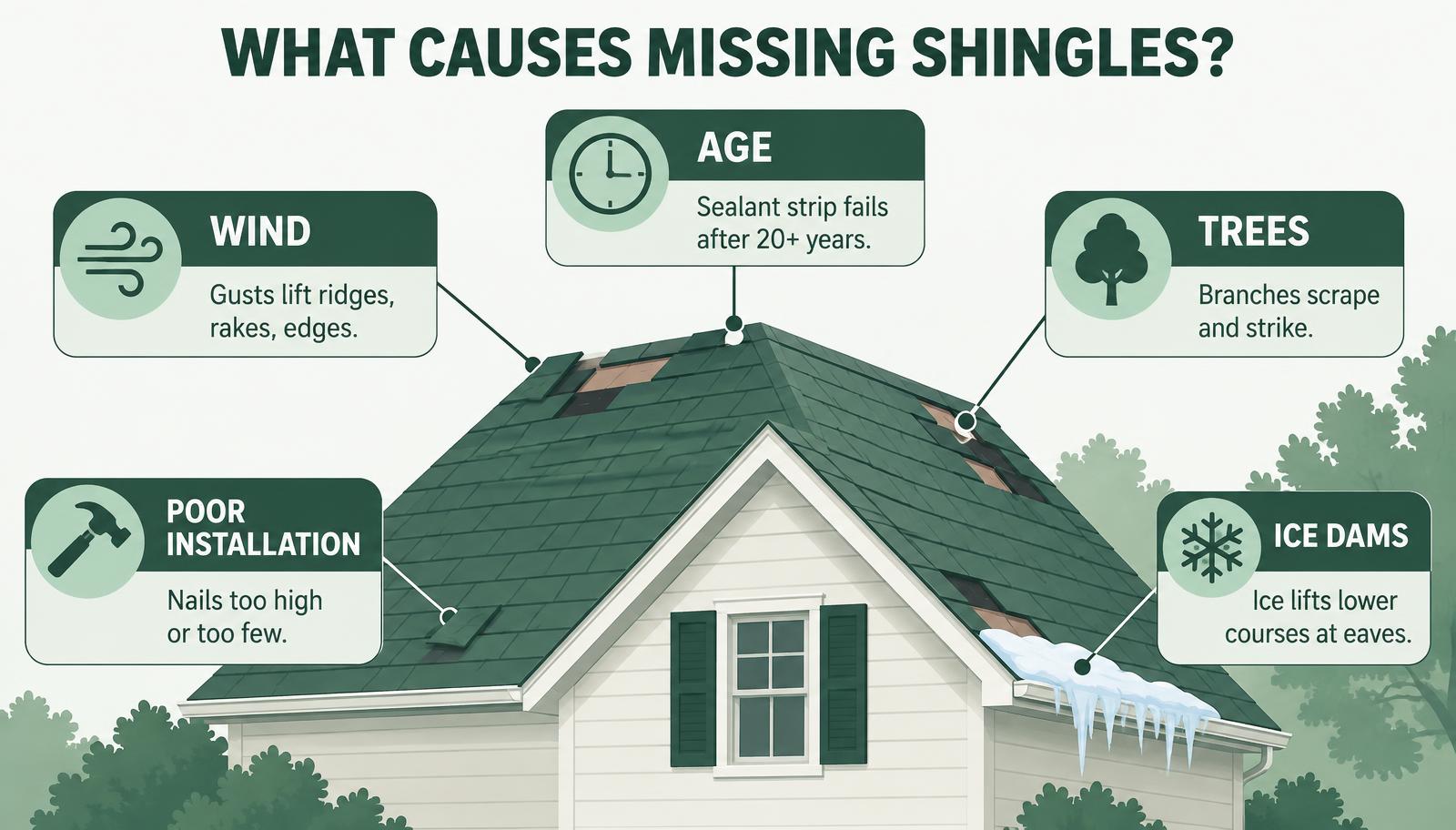
Shingles do not usually disappear without a reason. Understanding what caused them to come off tells you whether you are looking at an isolated repair or the beginning of a larger problem.
Wind Damage
Wind is the most common cause of missing shingles in the Philadelphia suburbs. Standard architectural shingles are rated for 60 to 130 mph winds depending on the product, but the real-world performance depends heavily on how well they were fastened at installation. Shingles with improperly placed or insufficient nails can lift and tear off in winds well below their rated limit.
The Main Line area is not hurricane country, but it sees regular nor’easters, late-summer tropical remnants, and fast-moving thunderstorm lines that routinely produce 50 to 70 mph gusts. Shingles that were already aging or that were installed with marginal fastening are the first to go.
Wind damage tends to show a pattern: shingles missing along ridges, rakes, and roof edges, where wind uplift is strongest. Random losses scattered across the field of the roof suggest a different cause.
Age and Thermal Cycling
Older shingles lose the adhesive sealant strip that bonds each course to the one below. Once that strip fails, shingles are held in place only by their nails — and a moderate gust is enough to pull them free. Roofs over 20 years old are particularly vulnerable during high-wind events because the adhesive has degraded across most or all of the surface.
Pennsylvania’s climate accelerates this process. The freeze-thaw cycles common in Chester, Montgomery, and Delaware counties put repeated thermal stress on shingle seals through fall and winter. A shingle that appeared secure in September may be ready to lift by the first heavy storm of the following spring.
Tree Impact
Overhanging branches that rub against the roof surface gradually abrade the granules from shingles, weakening them and eventually cracking them enough that sections break free. Large limbs or whole trees falling in storms can remove entire sections of shingles — or worse, puncture the deck below.
The heavily wooded lots that define much of Gladwyne, Villanova, and Newtown Square make tree-related damage particularly common here. If you have large trees near your home, periodic inspection of the roof surface for abrasion patterns is a worthwhile habit.
Poor Installation
Shingles that were improperly nailed — too high on the shingle body (above the nailing zone), too few nails per shingle, or with nails that missed the deck framing — have compromised holding power from day one. They are more likely to lift in wind events and more likely to develop water intrusion at the nail penetrations over time. If shingles start going missing on a roof that is only a few years old, installation error is worth investigating.
Ice Dams
In severe winters, ice dams that form at the eaves can lift the lower courses of shingles when the ice expands. The damage may not be visible until the ice thaws and the shingles are loose or missing. Homes with inadequate attic insulation are especially susceptible.

What to Do Right Now: Step-by-Step
When you notice missing shingles, the order of your response matters. Here is the right sequence.
-
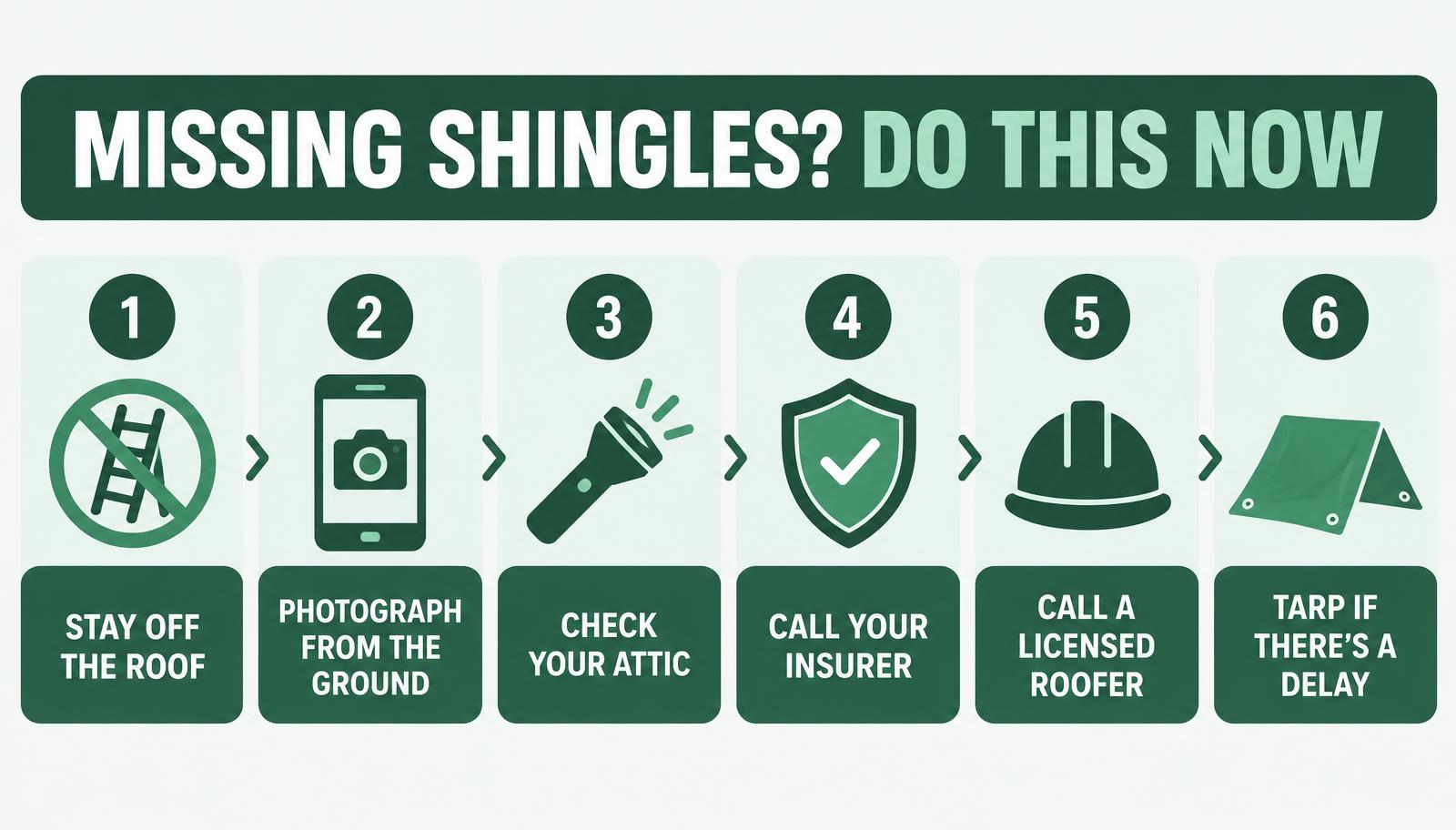
Do not go on the roof.
An exposed roof deck can be slippery, structurally compromised, or electrically dangerous if wires are involved. Leave the inspection to a professional. If water is actively entering your home, place buckets and move valuables out of the way, but do not attempt to access the roof.
-
Document everything from the ground.
Take photographs from every angle you can safely access — from the yard, from a window, from a neighboring viewpoint. If the damage is storm-related, photograph any debris, downed branches, or other evidence of the cause. Timestamp matters for insurance purposes, so use your phone’s native camera rather than a separate app.
-
Check your attic immediately.
Go into your attic with a flashlight and look for daylight coming through the deck, water stains on the sheathing, wet insulation, or active dripping. Any of these confirms that water has already entered. Note where the moisture is relative to the roof area above it.
-
Call your homeowners insurance company.
If the damage is storm-related — wind, hail, fallen tree — report it to your insurer before any repairs are made. Cleaning up or repairing without a claim number can affect your reimbursement. Most Pennsylvania policies cover sudden storm damage to the roof but exclude damage from wear, neglect, or pre-existing conditions. Your adjuster will want to see the undisturbed damage.
-
Call a licensed roofer for an inspection.
A professional can assess not just the visible missing shingles but also whether the underlayment below is intact, whether the deck has absorbed moisture, and whether surrounding shingles are loosened and likely to follow. This inspection also produces documentation that supports an insurance claim if you haven’t filed one yet.
-
Apply temporary protection if there will be a delay.
If a roofer cannot arrive within 24 to 48 hours and rain is in the forecast, a roofer — not you — should apply a temporary tarp or roofing membrane over the exposed area. Properly installed tarps are anchored to avoid creating new damage; an improperly secured tarp can cause more harm than the original missing shingles.
Missing Shingles on Your Main Line Home?
Mainline Roofing Pros offers same-day inspections for storm and wind damage across the Main Line, Delco, Montco, and Chester County. We document everything for insurance claims.
How Many Missing Shingles Are Too Many?
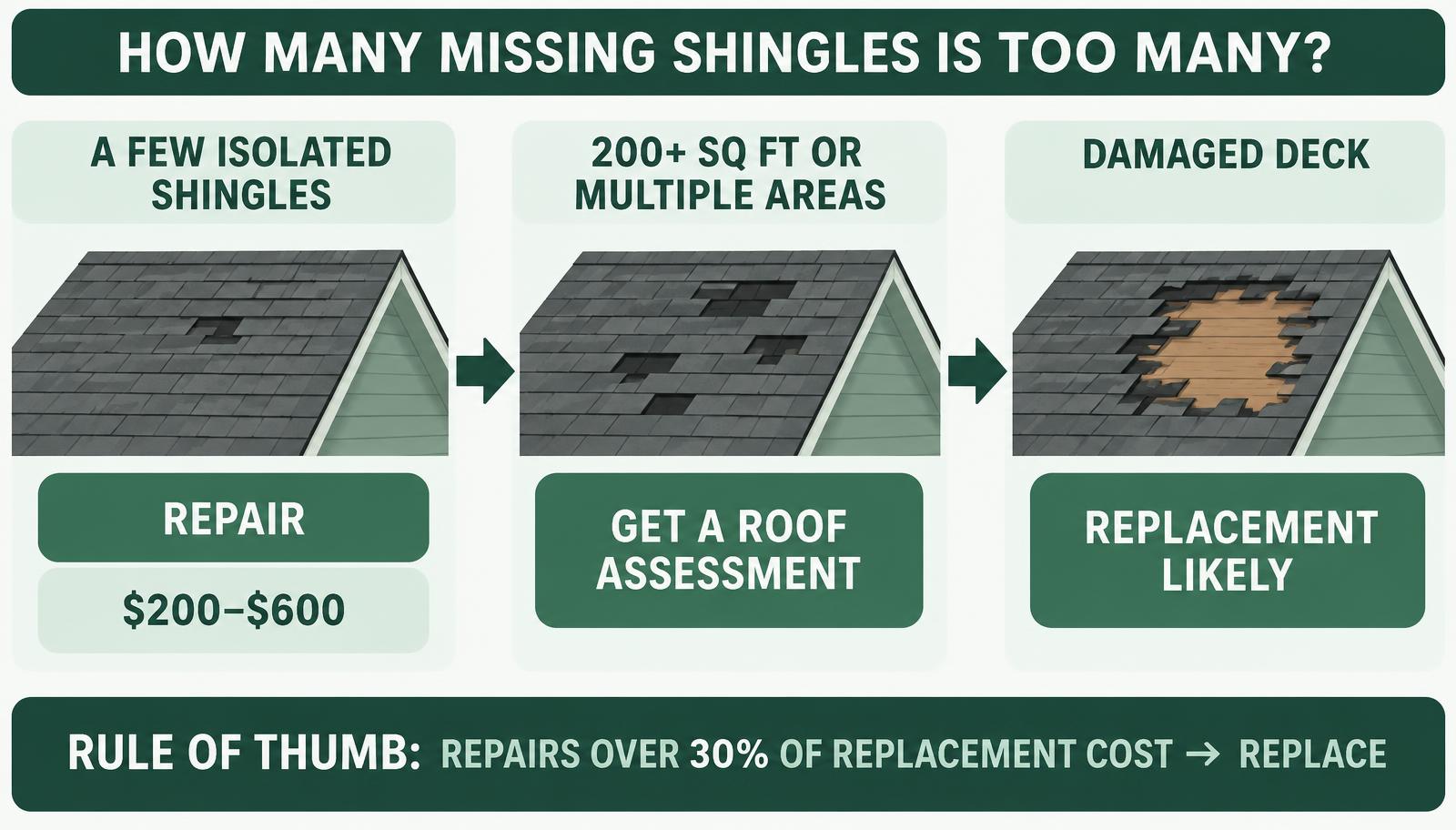
There is no universal number, but there is a useful framework. The question is really about scope, not count.
A Few Isolated Shingles — Repair
If you have one to a dozen missing shingles in a localized area, and the surrounding roof is in sound condition, a targeted repair is the right call. A roofer removes any damaged underlayment, replaces the shingles with matching material, and re-seals the area. This typically costs $200 to $600 for a small area in the Philadelphia suburbs, and can often be completed in a single visit.
The challenge with a repair on an older roof is color matching. Weathered shingles take on tones that differ from new ones, so patches may be visible. This is cosmetically imperfect but functionally fine — a good repair is still a good repair.
Significant Section Loss — Roof Assessment Required
If a large section of shingles is missing — say, more than 200 square feet — or if shingles are missing in multiple areas across the roof, a repair may not be the right approach. At that scale, the cost of a proper sectional repair starts approaching 25 to 30 percent of a full replacement cost. Most roofing professionals and insurers use this threshold as a decision point: if repairs exceed 30 percent of replacement cost, replacement is typically the better investment.
An aging roof that loses shingles in a significant event often has more shingles that are marginal but still attached. Replacing only the missing ones leaves a patchwork of old and new material with uneven performance. A full replacement versus repair evaluation from a licensed contractor gives you an honest picture of what makes financial sense.
Damage to the Deck — Replacement Likely
If shingles have been missing long enough for the deck (the plywood or OSB beneath) to absorb significant moisture, or if a tree strike has cracked or punctured the deck, the scope of the project expands beyond shingle replacement. Damaged decking must be replaced before new shingles go down, which adds both material and labor cost. On a roof that is already 20-plus years old, this often tips the decision toward full replacement.

Will Homeowners Insurance Cover Missing Shingles?
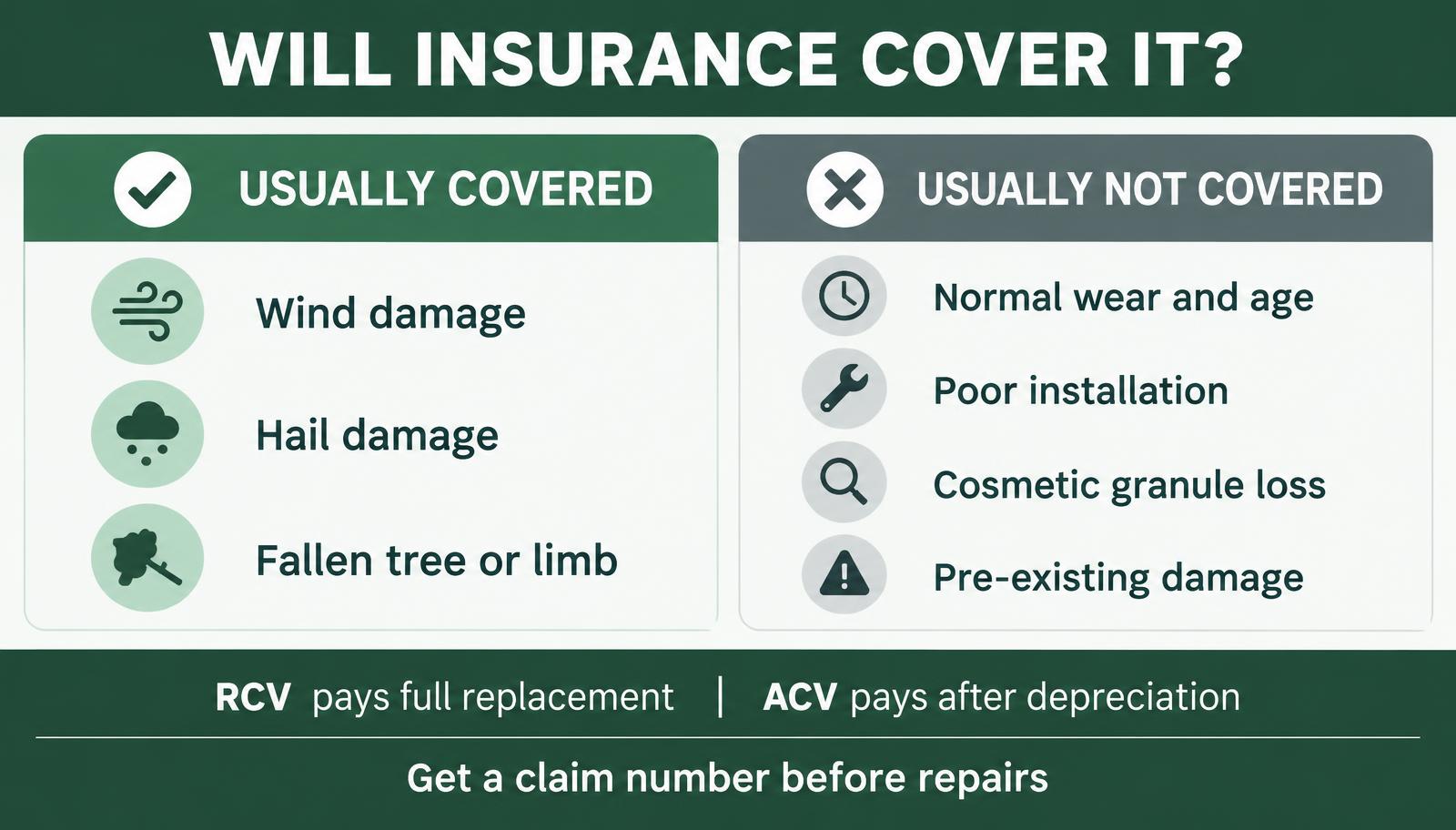
In most cases, yes — if the cause was sudden and storm-related. Pennsylvania homeowners insurance policies generally cover wind and hail damage as named perils. A nor’easter that lifts shingles off your Bryn Mawr Colonial or a thunderstorm that drops a limb on your Haverford roofline falls squarely within what a standard policy covers.
What insurance typically does not cover:
- Missing shingles caused by normal wear and age
- Damage from poor installation that predates the policy
- Cosmetic damage (granule loss, color fading) without functional impairment
- Pre-existing damage that was not disclosed at policy inception
The Matching Problem
Pennsylvania has consumer-protection provisions that affect how insurers handle partial repairs. When replacing storm-damaged shingles would result in visible mismatching with the undamaged portions of the roof — which is common on older roofs where the original shingle color is discontinued — some policies and some claim adjusters will authorize full replacement to maintain consistent appearance. This is worth discussing with your adjuster and your roofer together.
Documentation Is Everything
A roofer who inspects your property before any work is done produces a written assessment, photographs, and a scope of loss — all of which support your claim. Filing before repairs are made and having a contractor’s documentation in hand significantly strengthens your position with the insurer. Do not let a contractor start work before you have a claim number unless you are prepared to pay out of pocket.
Main Line insurance tip: Many Chester and Montgomery County homeowners have older roofs that insurers have already noted as a risk factor. If your roof is over 15 years old and you file a missing-shingle claim, the adjuster may factor in depreciation. A replacement cost value (RCV) policy pays full replacement; an actual cash value (ACV) policy pays after depreciation. Know which you have before the storm season.
Can You Replace Missing Shingles Yourself?
Technically, yes. Practically, it depends on the roof and what you are working with.
For a single missing shingle on a low-slope section of roof that is safely accessible, a competent DIYer with the right materials can make a functional repair. The process involves sliding the new shingle into position, nailing it in the correct zone, and sealing the exposed nail heads and edges with roofing cement. It is not complicated work.
The reasons most homeowners on the Main Line hire a professional instead:
- Safety. Falls from roofs are a leading cause of serious home-improvement injuries. Pitched roofs on the larger Colonials and Tudors common in the area are not safely walkable for most people.
- Warranty. DIY repairs on a roof still under a manufacturer warranty can void coverage. The warranty typically requires installation by a certified contractor.
- Insurance documentation. If you are filing a claim, a professional’s work comes with documentation. A DIY repair before the adjuster sees the roof can complicate your claim.
- Underlying damage. Missing shingles are visible. What is underneath them — saturated underlayment, lifted flashing, cracked decking — is not. A roofer assessing the area before repair catches problems a homeowner replacing shingles from a ladder would miss entirely.
- Matching. Finding the exact shingle color and profile to match your existing roof is harder than it sounds, particularly if the original product has been updated or discontinued.
What Happens If You Ignore Missing Shingles?
The short answer: it gets significantly more expensive.
A roof without shingles in a given area has only the underlayment — typically 15 or 30-pound felt, or synthetic sheeting — between the elements and your home. Underlayment is not designed as a long-term weather barrier. It can handle a few days of normal rainfall, but not extended exposure.
Timeline of water damage: Within hours of heavy rain, water can penetrate a compromised underlayment and begin soaking into the roof deck. Within days, saturated OSB or plywood begins to swell and delaminate. Within weeks, mold can establish in wet insulation. Structural framing can begin to rot within months. A $400 shingle repair ignored long enough becomes a $4,000 to $15,000 remediation project.
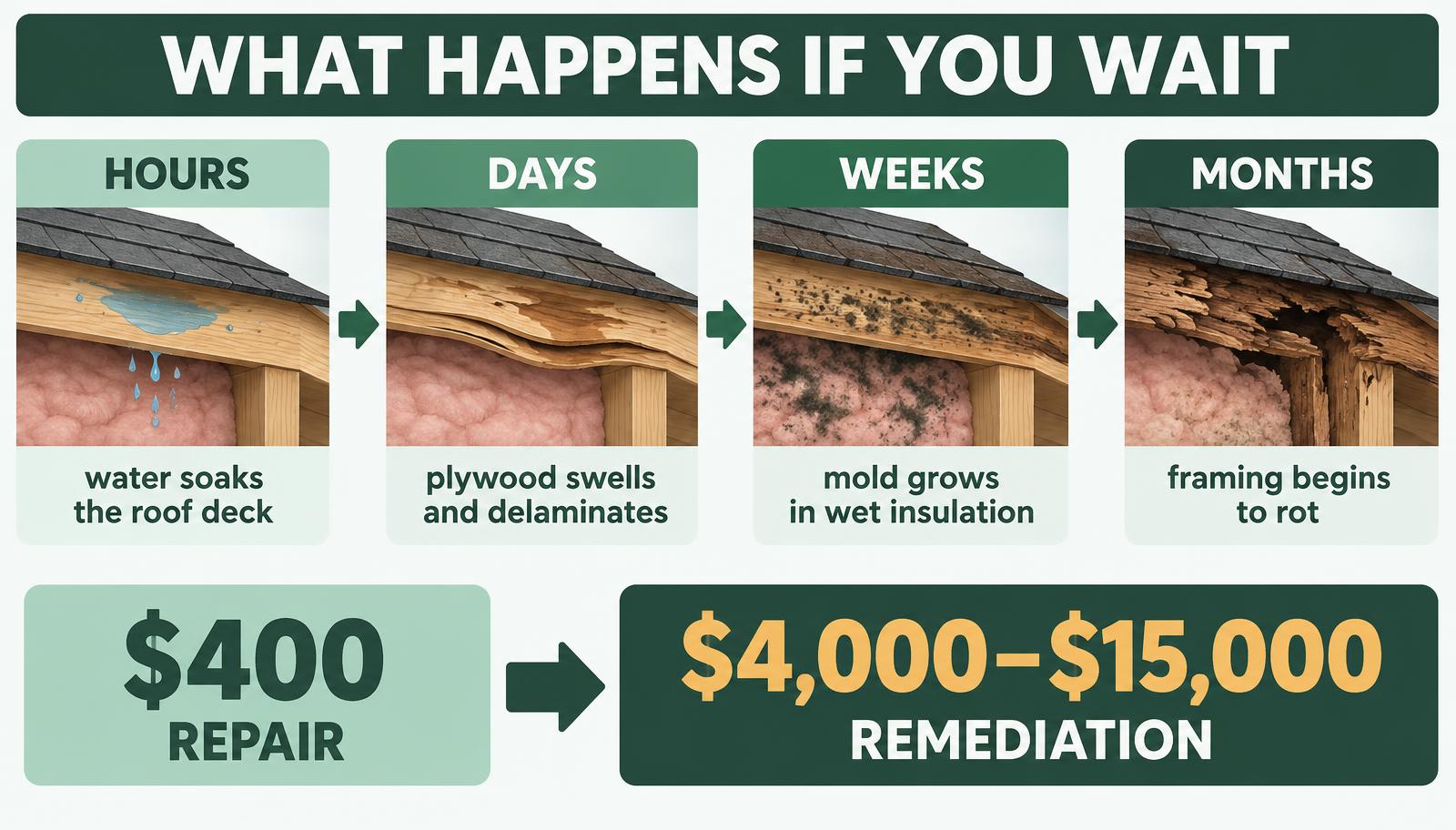
The interior damage from a roof leak — water-stained ceilings, damaged drywall, ruined insulation, mold growth — is often more expensive to repair than the roof repair itself. And unlike roof damage from a storm event, water damage caused by a known but neglected condition may not be covered by your homeowners policy. Insurers can and do deny claims when they can demonstrate that the homeowner was aware of a problem and failed to act on it.
Missing Shingles vs. Wind Damage Shingles: What Is the Difference?
When shingles are damaged by wind but not yet gone, you may see them lifted at the corners, cracked across the middle, or creased and partially detached. This is wind damage to shingles — the shingles are still nominally in place but no longer providing full protection. Rain can drive under lifted corners. Cracked shingles allow water infiltration at the break.
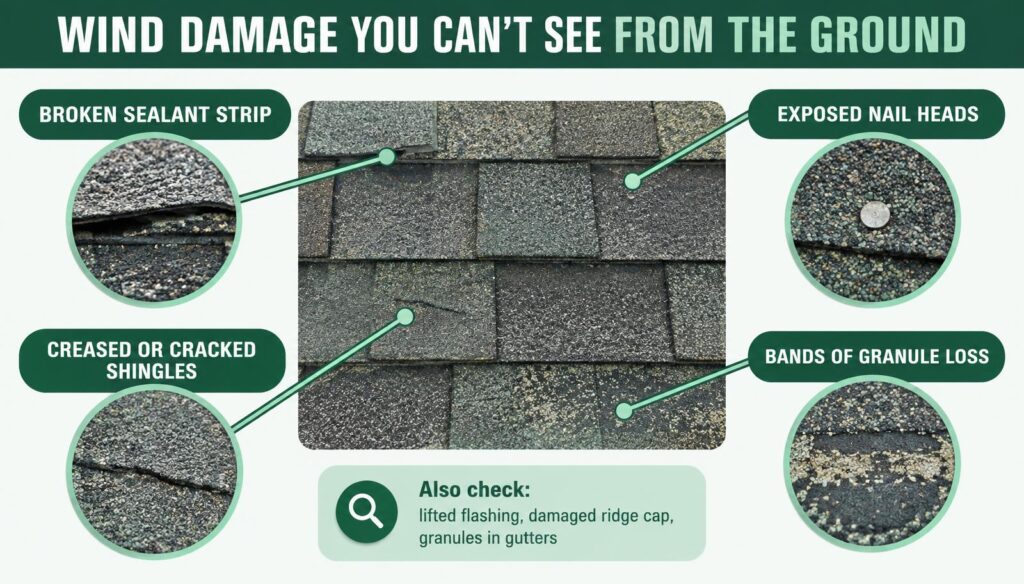
Wind-damaged shingles that are still attached are not always easy to spot from the ground. An inspector walking the roof can identify:
- Shingles with broken sealant strips that are no longer bonded to the course below
- Shingles with exposed nail heads where wind has shifted the position
- Creased or cracked shingles that will fail with the next significant weather event
- Granule loss concentrated in bands, indicating where wind has abraded the surface
Both missing shingles and wind-damaged shingles that are still in place are covered causes under most storm-damage insurance policies. An inspection that documents both conditions — not just the ones already gone — gives you a more complete picture and a stronger claim.
Storm Damage on Your Roof?
Mainline Roofing Pros documents wind and storm damage across the Main Line for insurance claims. We inspect the full roof, not just the obvious missing areas.
Signs of Storm Damage to a Roof Beyond Missing Shingles
After a significant storm event, missing shingles are the most obvious visible sign of damage — but not the only one worth checking for.
- Granule loss: Asphalt shingles are coated with ceramic granules that protect the asphalt from UV degradation. Hail strikes and severe wind abrasion knock granules loose. You’ll see them collecting in gutters and downspout splash zones after a storm.
- Lifted flashing: Metal flashing at chimneys, skylights, dormers, and valleys can be bent or lifted by wind, compromising one of the most water-sensitive areas of any roof.
- Damaged ridge cap: The ridge cap shingles at the peak of the roof are exposed to wind from all directions and are among the first to go. Check the ridgeline for gaps or lifted sections.
- Gutters torn from fascia: Heavy debris or wind can pull gutters away from the fascia board, which can also indicate damage to the drip edge below the first shingle course.
- Interior water stains: New stains on ceilings or in the attic after a storm are a reliable indicator that water has entered, even if you can’t yet see visible exterior damage from the ground.
Repair Cost: What to Expect on the Main Line
Missing shingle repair costs in the Philadelphia suburbs depend on the number of shingles affected, the roof pitch, and whether any underlayment or decking needs attention.
| Scope of Repair | Typical Cost (Main Line, 2026) | Notes |
|---|---|---|
| 1–5 missing shingles, accessible area | $200–$450 | Standard repair; no deck or underlayment damage |
| 6–20 missing shingles, single section | $400–$900 | May include partial underlayment repair |
| Large section (100–200 sq ft) | $800–$2,000 | Approaches replacement cost threshold on older roofs |
| Deck damage included | Add $300–$900 per sheet of plywood | Saturated or cracked OSB/plywood must be replaced |
| Emergency tarping (contractor-installed) | $150–$400 | Temporary protection while waiting for full repair |
These figures reflect standard residential roofing in the Delaware County, Montgomery County, and Chester County markets. Steep roofs, complex geometry (multiple valleys, dormers, skylights), and premium shingle materials all add to the cost. The best starting estimate for your specific home is through our roofing cost calculator, followed by an on-site inspection.
Choosing a Roofer for Missing Shingle Repair
Not every roofing contractor is the right fit for a missing-shingle repair. Here is what to look for specifically in this situation.
- Licensed and insured in Pennsylvania. Roofing contractors in PA must carry general liability and workers’ compensation. Ask for certificates before anyone gets on your roof.
- Experience with the same shingle manufacturer. If your roof is GAF or CertainTeed, a contractor certified by that manufacturer can pull from their product line and access full warranty documentation. Mismatched materials from an uncertified contractor can void your existing shingle warranty.
- Written scope of work before any money changes hands. A reputable contractor gives you a written assessment of what they found and what they are proposing to repair — before you agree to anything. Storm-chasing contractors who show up uninvited and pressure you to sign quickly are a warning sign.
- Insurance claim experience. If you are filing a claim, choose a contractor who has worked directly with insurance adjusters and knows how to document damage in a format that supports a claim.
- Local references. A contractor who has worked extensively in your specific community — Ardmore, Haverford, Wayne, Media — understands the common roof types, typical storm patterns, and HOA or neighborhood standards that can affect what gets installed.
FAQs: Missing Shingles
How urgent is it to replace missing shingles?
Very urgent. An exposed roof deck has only the underlayment between your home and rain. Standard felt underlayment will hold up for a short time, but it is not a permanent weather barrier. If rain is forecast within 48 to 72 hours, getting a roofer on the problem — or at minimum a contractor-installed temporary tarp — should be a same-day priority. The cost of water damage to ceilings, insulation, and framing consistently exceeds the cost of the shingle repair itself.
Can missing shingles cause a leak?
Yes, and often quickly. Once the underlayment is exposed, the only remaining protection is a single layer of water-resistant paper or synthetic sheeting. In a moderate rainstorm, water can work through seams, nail holes, or imperfections in that underlayment and begin entering the structure below. The attic is the first place to look — check for daylight, dampness, or new staining after any significant rain event.
Will my homeowners insurance cover missing shingles?
If the cause was a storm event — wind, hail, or a fallen tree — most standard Pennsylvania homeowners policies cover missing shingles as sudden and accidental damage. Coverage is typically denied for shingles lost due to age, neglect, or pre-existing deterioration. File the claim before repairs are made, document the cause thoroughly, and have a licensed roofer produce a written damage assessment to support the claim.
How many missing shingles before roof replacement?
There is no fixed number, but the standard industry threshold is cost-based: if the repair would cost more than 25 to 30 percent of a full replacement, replacement usually makes more financial sense — particularly on an older roof. For context, if your roof would cost $15,000 to replace fully, repairs that exceed $4,000 to $4,500 are often better put toward a replacement. A licensed roofer can give you both figures after a proper inspection.
Can you shingle over missing shingles?
No. New shingles cannot simply be applied over an area where shingles are missing. The underlying courses have to be intact to provide the proper layering and fastening surface. In some cases, where a roof still has its original single layer of shingles and is otherwise sound, a full re-roof over the existing layer is code-permitted — but that is a different situation than patching missing sections. Missing shingle repair always involves properly integrating new shingles with the existing surrounding courses.
What do wind-damaged shingles look like?
Wind damage to shingles appears in several forms: shingles that are missing entirely, shingles that are cracked or creased across the middle (a sign of the shingle being lifted past its flex point), shingles with lifted or curled corners where the sealant strip has broken, and shingles still in position but with the granule surface abraded or scoured by debris-laden wind. Some wind damage is only identifiable from the roof surface itself, not from the ground — which is one reason a professional inspection after a significant storm is worth doing even when no obvious missing shingles are visible.
How long does a missing shingle repair take?
For a small area — a handful of missing shingles in a localized section — an experienced roofing crew can typically complete the repair in two to four hours. Larger repairs, or repairs that uncover underlying damage to the deck or flashing, take longer and may require a second visit if materials need to be ordered. For most Main Line properties, an urgent repair can be scheduled and completed within one to three business days of the initial inspection.
Can I replace shingles myself?
A single missing shingle on a safely accessible, low-slope section of roof can technically be replaced by a careful homeowner with the right materials. However, most roofing professionals advise against DIY repairs on pitched roofs due to fall risk, warranty implications, and the likelihood that the visible missing shingle is not the only problem present. If you are filing an insurance claim, any DIY work done before the adjuster inspects the property can complicate or reduce your reimbursement.
Do missing shingles affect home value?
Yes, and more significantly than most homeowners expect. A visible roof defect — missing shingles, damaged sections, visible patching — is a red flag for buyers and their inspectors. In a competitive market like the Main Line, a roof in poor condition can result in price reductions, repair credits, or buyers walking away entirely. Addressing missing shingles promptly protects both the structure and the long-term value of the property.
More Roofing Guides from Mainline Roofing Pros
Serving homeowners across the Main Line, Delaware County, Montgomery County, and Chester County.
Bottom Line
Missing shingles are an urgent problem, not a cosmetic one. The window between “a few shingles are gone” and “there’s water in your walls” can be measured in a single rainstorm. Act quickly: document the damage, call your insurer if the cause was storm-related, and get a licensed roofer out to assess the full picture — not just the obvious gaps.
For most homes across Bryn Mawr, Havertown, Collegeville, and the broader Main Line area, a prompt missing-shingle repair is a straightforward, affordable job. Waiting turns it into something significantly more expensive.
Mainline Roofing Pros provides same-day storm damage inspections across the Main Line and surrounding suburbs. We document the full scope of damage, work directly with insurance adjusters, and carry the manufacturer certifications needed to protect your warranty. Reach out and we’ll be out to take a look.
Missing Shingles? Don’t Wait.
Every day without shingles is a day your roof deck is exposed to the elements. Mainline Roofing Pros offers fast inspections and same-day repair scheduling across the Main Line, Delco, Montco, and Chester County.

Founder & Owner of Main Line Roofing Pros. 22+ years of local roofing expertise serving Main Line, Delco, Montco & Chesco homeowners with honest, high-quality work.