
Trusses vs Rafters: How Your Roof Is Framed and Why It Matters
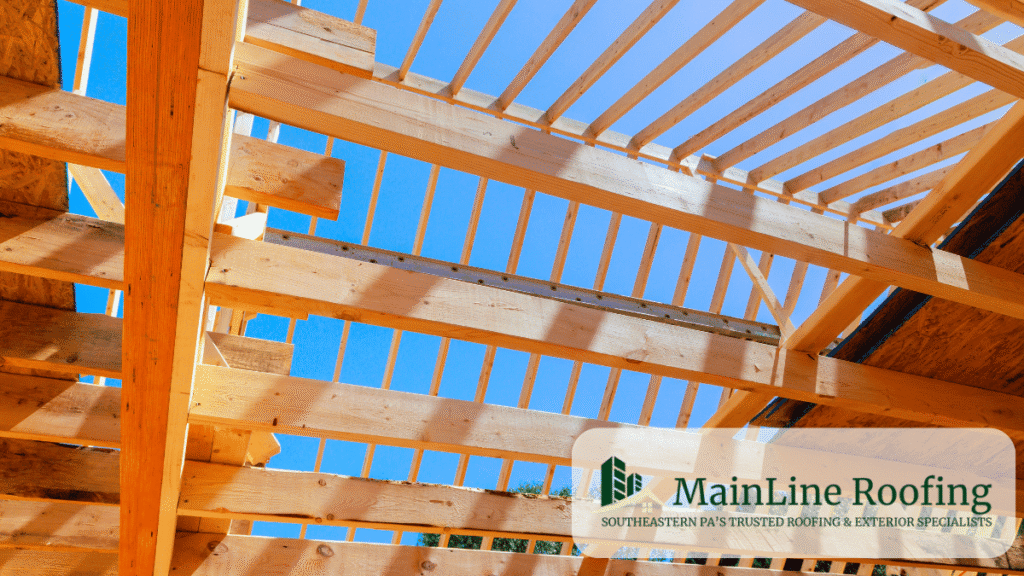
Somewhere above your ceiling, a framework of wood is holding up your roof. That structure is built from either rafters or trusses. Most homeowners have no idea which they have, and for most everyday purposes it doesn’t matter. But when it comes to roofing work, attic renovations, or any structural project above the top floor, the difference matters a lot.
This guide explains what rafters and trusses are, how they differ structurally, how to tell which one you’re dealing with, and what each system means for your home’s roof.
What Are Rafters?
Rafters are individual structural boards that run diagonally from the ridge of the roof down to the exterior walls. They’re installed one at a time on the job site, each one measured, cut, and nailed in place by a framer or carpenter working directly on the structure.
A traditional rafter-framed roof is built piece by piece. In addition to the rafters themselves, the system typically includes:
- A ridge board at the peak where opposing rafters meet and are nailed
- Ceiling joists running horizontally between the exterior walls to resist outward thrust
- Collar ties or rafter ties connecting opposing rafters partway up to prevent spreading
- Purlins, knee walls, or ridge beams in some designs for additional support over longer spans
This style of construction is often called stick framing because every piece is cut and assembled individually on site. It requires skilled labor and takes more time, but it creates open attic space and allows for custom roof shapes that engineered trusses can’t easily replicate.
What Are Trusses?
Trusses are pre-engineered structural units manufactured in a factory and delivered to the job site fully assembled. Each truss is a complete triangular framework made from smaller dimensional lumber connected at joints with metal connector plates, also called gang plates or gusset plates.
A standard roof truss is made up of three main components:
- Top chords – the two sloping sides of the triangle that support the roof decking
- Bottom chord – the horizontal base that sits on the wall plates and supports ceiling loads
- Web members – the internal diagonal and vertical pieces that complete the triangular pattern and transfer loads
Trusses are lifted into place from below, typically with a small crane or manually by the framing crew, then spaced evenly across the wall plates and braced. Because each truss is engineered to exact specifications for its span and load, installation is fast – the entire roof structure of a typical home can be framed in a day or two.
Key concept: Rafters are built on site, one piece at a time. Trusses are manufactured in a factory as complete units and installed as finished assemblies. That single difference drives most of what’s distinct about the two systems.
Trusses vs. Rafters: Head-to-Head Comparison
| Feature | Rafters (Stick Framing) | Trusses |
|---|---|---|
| Construction method | Cut and assembled on site | Factory-engineered, delivered complete |
| Attic space | Open, potentially usable | Web members obstruct the space |
| Span capability | Moderate, requires interior bearing walls for long spans | Can span large widths without interior support |
| Installation labor | Higher – more skilled labor, more time | Lower – faster, less on-site skill required |
| Material cost | Comparable lumber but more pieces | Factory production reduces per-unit cost |
| Modifiability | Easier to modify with proper engineering | Very difficult – any change requires engineer approval |
| When most common | Pre-1970 homes, custom construction | Most homes built after 1970 |
| Custom roof shapes | Highly flexible for complex designs | Custom trusses possible but more expensive |
How to Tell If You Have Rafters or Trusses
The easiest way is to look in your attic.
If you see rafters: You’ll notice large individual boards running from near the peak of the roof down toward the exterior walls, with open triangular space between them. The attic feels open and relatively clear from one side to the other. The boards are typically 2×6, 2×8, 2×10, or larger depending on span and age of the home.
If you see trusses: You’ll see a series of identical triangular frames spaced at regular intervals across the width of the attic – typically 24 inches on center. Inside each frame you’ll notice the web members: the diagonal and vertical inner pieces that fill in the triangular shape. The space is there, but it’s divided and obstructed by those internal members.
If you can’t access your attic, age is a reliable guide. Homes built before roughly 1965 to 1970 in the Philadelphia region almost always have rafter framing. Homes built after that, particularly production-built subdivisions, are very likely to have trusses. Custom-built homes are the exception – custom construction at any era may use rafters by design to preserve attic space for living area.
What Each System Means for Attic Space
This is the most significant practical difference for most homeowners.
Rafter-Framed Attics
The space between the rafter pairs is open from the ridge down to the wall plates. You can walk through the attic relatively freely. Storage is straightforward. And with the right permits, engineering, and work, the space can be converted into finished living area – a bedroom, office, or bonus room. Many older Cape Cods and colonials in Merion Station, Gladwyne, and across the Main Line were originally built this way and have had their attics finished over the years.
Truss-Framed Attics
The web members run through the middle of the triangular space, dividing it in ways that make standing or moving through most of the attic impossible. You can often store lightweight items in the lower section between the bottom chord and the floor, but the volume above is broken up and not practically usable. You cannot remove or cut any web member without re-engineering and replacing the truss – the entire triangular system depends on each member to function.
Critical warning: Never cut, notch, drill, or modify a truss member without approval from a licensed structural engineer. Trusses are engineered as a complete system. Altering any single member – even one that looks unimportant – redistributes loads in ways that can cause sudden failure. This is true even for small notches or holes.
What This Means for Roofing Work
For a standard roof replacement – tear off the old shingles, install new underlayment and new shingles – it doesn’t significantly matter whether you have trusses or rafters underneath. Both systems support the roof decking from below, and neither requires the roofer to do anything different on the surface.
Where the framing type matters for roofing work:
Ventilation Design
Rafter-framed attics and truss-framed attics have different ventilation requirements. Rafter bays typically use foam baffles to maintain an air channel from the soffit to the ridge. Truss attics have their own airflow patterns that need to be understood when designing or upgrading the ventilation system. See our guide on what a ridge vent does for context on how attic ventilation affects the roof above.
Ridge Vent Installation
Cutting the slot at the ridge for a ridge vent requires knowing what’s immediately below. A roofer needs to clear the structural members and avoid cutting into anything load-bearing. This is straightforward with knowledge of the framing below.
Decking Repair
When sections of roof decking are damaged and need replacement, the repair approach depends on the framing below. Decking panels span between framing members, so knowing the spacing of trusses or rafters helps a roofer cut and fit replacement panels correctly.
Structural Concerns
If a rafter is sagging, cracked, or damaged, it can be sistered – a new rafter of the same dimensions nailed alongside the damaged one. If a truss is damaged, the repair typically requires a structural engineer’s assessment because modifying the truss without re-engineering it is not an option.
Which Is Better – Trusses or Rafters?
Neither system is inherently better. They solve the same structural problem in different ways with different trade-offs.
Trusses won the market because they’re faster to install, require less on-site skilled labor, can span long distances without interior load-bearing walls, and are engineered to precise tolerances. For builders constructing hundreds of similar homes, those advantages add up significantly.
Rafters remain the choice for custom homes where attic space matters, where unusual roof shapes are part of the design, or where the architect wants flexibility in how the interior volume can be used. Many custom homes being built today in Villanova, Bryn Mawr, and other areas with large custom homes still use rafter framing by choice.
If you’re a homeowner trying to understand what you have and what it means, the honest answer is that for a standard roof replacement or repair, it won’t change much. If you’re thinking about converting attic space, it changes everything.
Have Questions About Your Specific Roof?
Mainline Roofing Pros serves homeowners across the Main Line, Delaware County, Montgomery County, and Chester County. We’re happy to walk you through what you have and what it means.
Common Roof Types and Their Framing
Knowing your home style gives you a strong starting guess on what’s above your ceiling:
| Home Style / Era | Likely Framing | Notes |
|---|---|---|
| Pre-1960 Cape Cod or Colonial | Rafters | Often has finished or semi-finished attic space |
| 1920s-1950s twins and rowhomes | Rafters | Shallow attic, close rafter spacing |
| 1960s-1970s ranch homes | Mixed – check | Transition era; either is possible |
| Post-1975 production homes | Trusses | Very likely trusses in any production subdivision |
| Custom homes, any era | Often rafters | Depends on design intent; confirm in attic |
| Post-2000 custom construction | Either | Trusses or rafters depending on design and architect |
Frequently Asked Questions About Trusses vs. Rafters
Can I tell from outside whether my home has trusses or rafters?
Not reliably. The exterior of the roof looks the same either way – both systems support the same decking, underlayment, and shingles. The only way to know for sure is to look from inside the attic.
Are trusses stronger than rafters?
Both systems are engineered or designed to carry the required loads for their application. Trusses are precision-engineered for specific spans and loads. Rafters rely on traditional sizing tables and the framer’s skill. When properly designed and installed, both perform well. “Stronger” depends on the specific design, not the system type.
Can I remove a truss to add attic living space?
Not without a structural engineer’s review and permits. Trusses are designed as a complete system. Removing or cutting any web member changes the load path through the entire truss and can cause it to fail. If you want to convert attic space in a truss-framed home, a structural engineer can sometimes design an alternative support system, but it’s a significant and expensive project.
Does it cost more to replace a roof on a truss-framed home vs. a rafter-framed home?
Not significantly for a standard replacement. The surface area, pitch, and complexity of the roof are the main cost drivers. The framing below has minimal impact on a shingle replacement unless decking repairs are needed or structural issues are found.
My rafter is sagging. Is that serious?
It depends on the cause and extent. Sagging rafters can indicate rot, termite or pest damage, overspanning, undersized lumber for the span, or overloading from heavy snow or ice. A single sagging rafter can often be sistered – a new matching board nailed alongside it. If multiple rafters are affected, or if there’s rot or moisture damage, further evaluation is needed. This is different from a sagging truss, which requires an engineer.
What does vaulted ceiling construction mean for trusses vs. rafters?
Vaulted ceilings require the roof framing and ceiling to follow the same slope, which typically means using raised-heel trusses, scissors trusses, or rafter framing. Standard flat-bottom trusses create a flat ceiling. If your home has vaulted ceilings, you either have a specialized truss design or rafter framing – look in the space between the ceiling and the roof deck (if accessible) or consult your original building plans.
More Helpful Roofing Guides from Mainline Roofing Pros
Serving homeowners across the Main Line, Delaware County, Montgomery County, and Chester County.
Bottom Line
The difference between trusses and rafters comes down to how the roof is framed: factory-built units versus custom site-built construction. For a standard roof replacement in Newtown Square, Upper Darby, Ardmore, or anywhere else we serve, the type of framing below the decking rarely changes what needs to happen on the surface. But if you’re thinking about attic space, structural modifications, or you want to understand a contractor’s assessment, knowing which system you have puts you in a better position.
Questions About Your Roof Structure?
Mainline Roofing Pros assesses the full roof system before making any recommendations. If you’re seeing signs of structural movement, sagging, or damage, reach out for an inspection.

Founder & Owner of Main Line Roofing Pros. 22+ years of local roofing expertise serving Main Line, Delco, Montco & Chesco homeowners with honest, high-quality work.